

First quantum physicist from a Singapore university to receive prestigious Infosys Prize 2026
First quantum physicist from a Singapore university to receive prestigious Infosys Prize 2026
SUTD Assistant Professor Manoj Kumar Joshi has been awarded the Infosys Prize 2026 in Physical Sciences, for his pioneering contributions to quantum science and technology, particularly through experiments involving large, individually controlled arrays of trapped ions. His recognition marks a significant milestone for Singapore’s research community, as he is the first quantum physicist based in a local university to receive the Infosys Prize.
Prof Manoj Kumar Joshi receives the Infosys Prize 2026 in Physical Sciences for seminal advances in developing and demonstrating scalable trapped-ion quantum simulation. His innovations in cooling, control and measurement enabled programmable simulators with more than 50 ions. Prof Joshi contributed decisively to realizing the Schwinger model, bringing lattice gauge theory simulations into the laboratory, and played a leading role in observing the quantum Mpemba effect, where states initially farther from symmetry can restore it faster.
Extract of jury citation (Read more)
Instituted by the Infosys Science Foundation, the Infosys Prize is one of India’s leading awards recognising excellence in scientific research and scholarship since 2009. Presented annually across six categories, the prize recognises outstanding contributions by researchers aged 40 or younger whose work demonstrates originality, innovation and the potential to advance their respective fields. Each award comprises a gold medal, a citation and a cash prize of USD 100,000.
A specialist in quantum particle manipulation, large-scale quantum simulation and entanglement studies
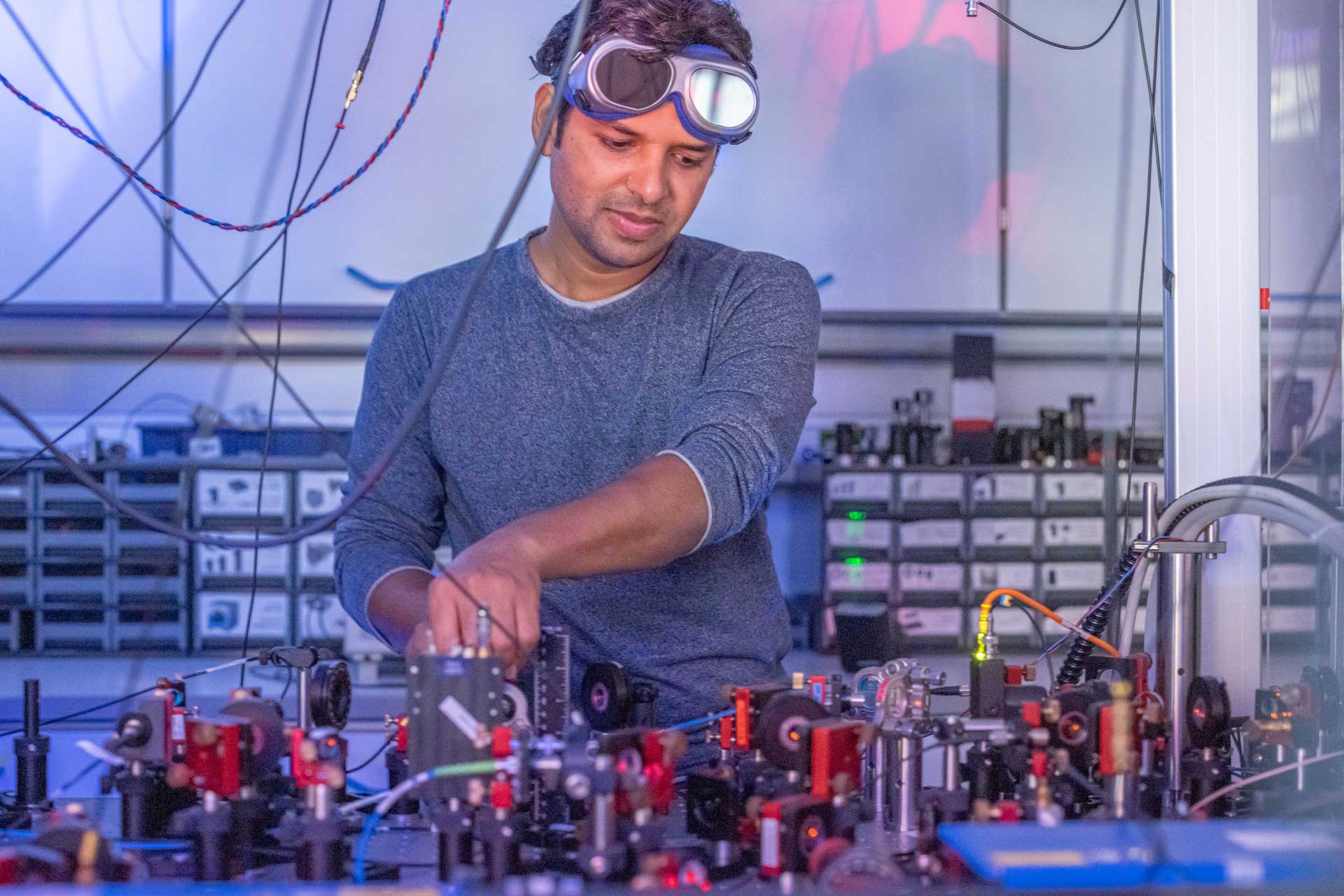
Photo credit: Daniel Hinterramskogler
Currently a faculty member with the Science, Mathematics and Technology (SMT) cluster at SUTD, Assistant Prof Joshi is an experimental physicist who specialises in the control and manipulation of individual quantum particles, particularly trapped atomic ions. He uses trapped-ion systems as programmable quantum simulators to investigate fundamental phenomena in quantum many-body physics and develop new quantum technologies.
Prior to joining SUTD in April 2026, Assistant Prof Joshi conducted research at the Institute for Quantum Optics and Quantum Information (IQOQI) and the University of Innsbruck, Austria, where he worked closely with leading researchers in the field, including Professors Rainer Blatt, Christian Roos and Peter Zoller. His work has helped establish trapped-ion quantum simulators as powerful experimental platforms for investigating fundamental questions in quantum physics, connecting concepts from quantum information theory, statistical mechanics and quantum field theory with experiments on controllable many-body systems.
At SUTD, he is now developing the next generation of trapped-ion quantum platforms, with the broader objective of connecting fundamental discoveries in quantum physics with practical applications in quantum technologies and contributing to Singapore’s position as a centre for quantum research and innovation.
For more than a decade, Assistant Prof Joshi has been at the forefront of experimental research demonstrating and investigating quantum phenomena like entanglement, quantum information scrambling, hydrodynamics and thermalisation, using trapped-ion systems. These experiments showcase the capabilities of trapped-ion quantum hardware and provide a powerful platform for exploring fundamental questions in physics and emerging quantum technologies.