

ISTD faculty showcase research excellence at the 43rd International Conference on Machine Learning (ICML 2026)
ISTD faculty showcase research excellence at the 43rd International Conference on Machine Learning (ICML 2026)
Faculty members from SUTD’s Information Systems Technology and Design (ISTD) pillar, including Professor Xiaoli Li, Associate Professor Jihong Park, Assistant Professor Wenxuan Zhang, Assistant Professor Na Zhao, and their research teams, participated in the 43rd International Conference on Machine Learning (ICML 2026) held in Seoul, South Korea.
Widely recognised as one of the world’s leading conferences in machine learning and artificial intelligence, ICML brings together top researchers from academia and industry to share the latest breakthroughs in AI research. The conference provided an excellent platform for ISTD faculty to present their work, strengthen collaborations with international partners, and exchange ideas with researchers from around the globe.
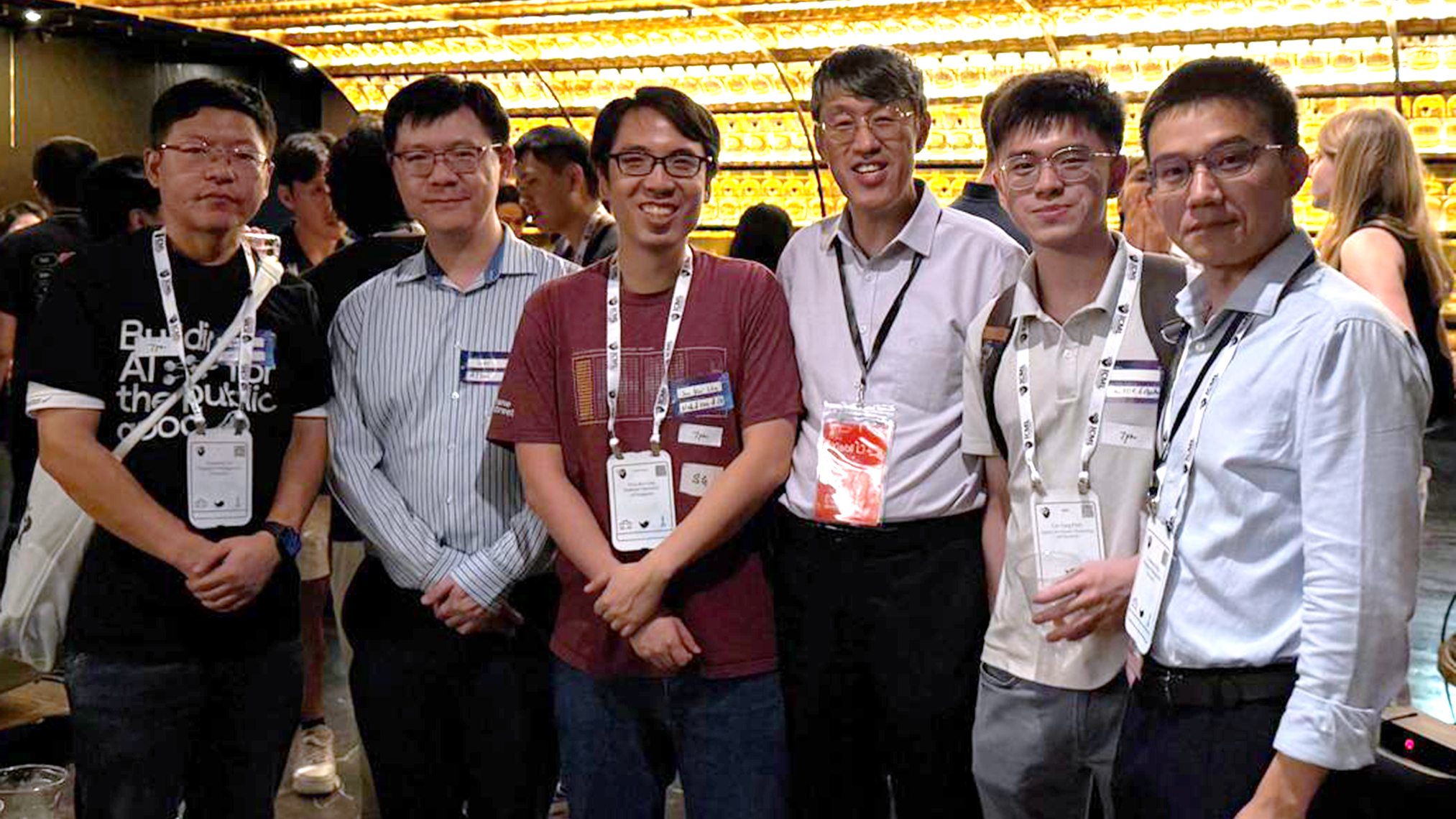
Strengthening Singapore’s global AI presence
Beyond research presentations, Professor Xiaoli Li and Associate Professor Jihong Park also contributed to Singapore’s presence at ICML by supporting the Singapore Smart Nation Booth and participating in the Singapore AI Networking Mixer. The event brought together representatives from Singapore’s AI ecosystem, including AI Singapore (AISG), Infocomm Media Development Authority (IMDA), National Research Foundation, Singapore (NRF), National University of Singapore (NUS), Nanyang Technological University (NTU), Singapore Management University (SMU), SUTD, Agency for Science, Technology and Research (A*STAR), DSO National Laboratories (DSO), and the Embassy of Singapore in the Republic of Korea, alongside industry and research partners from around the world.
11 papers accepted at ICML 2026
ISTD Pillar achieved a significant milestone with 11 papers accepted to ICML 2026, highlighting SUTD’s growing impact across a broad spectrum of AI research areas, including large language models, multimodal AI, embodied intelligence, robotics, trustworthy AI, federated learning, time series analytics, and generative AI.
- Large language models & multimodal AI
Research topics included vision-language models, cultural alignment of LLMs, multimodal reward modelling, and AI safety. One representative paper is Training Data Efficiency in Multimodal Process Reward Models, co-authored by Assistant Prof Wenxuan Zhang. - Embodied AI, robotics & autonomous systems
Research contributions covered structured visual reasoning, perception-policy learning, 4D LiDAR generation, radar scene flow estimation, and 3D scene understanding. A notable paper is Artemis: Structured Visual Reasoning for Perception Policy Learning, co-authored by Assistant Prof Na Zhao. - Trustworthy & distributed AI
ISTD researchers advanced secure and scalable AI systems through work on federated learning. One accepted paper is Breaking the Capacity Bottleneck in Model-Heterogeneous Federated Learning via Gradual Model Restoration, co-authored by Associate Prof Jihong Park. - Time series AI
Research in this area focused on anomaly detection and sensor data analytics. IMPACT: Influence Modeling for Open-Set Time Series Anomaly Detection, co-authored by Prof Xiaoli Li, was among the accepted papers. - Generative AI
ISTD researchers also contributed to creative AI applications through SonicMaster: Towards Controllable All-in-One Music Restoration and Mastering, which explores AI-powered music restoration and mastering, co-authored by Associate Prof Dorien Herremans.
Congratulations to all our faculty members, students, postdoctoral researchers, alumni, and collaborators on this remarkable achievement. We look forward to more inspiring discussions, impactful collaborations, and exciting research breakthroughs throughout ICML 2026 and beyond.
The accepted papers are listed below and can be accessed via their respective ICML 2026 presentation pages.
Large language models & multimodal AI
- Self-Captioning Multimodal Interaction Tuning: Amplifying Exploitable Redundancies for Robust Vision Language Models
- Distributional Open-Ended Evaluation of LLM Cultural Value Alignment Based on Value Codebook
- Training Data Efficiency in Multimodal Process Reward Models
- TokenSwap: Backdoor Attack on the Compositional Understanding of Large Vision-Language Models
Embodied AI, robotics & autonomous systems
- Artemis: Structured Visual Reasoning for Perception Policy Learning
- HieraScaffold: Learning Compact Hierarchical Representations for Scalable 4D LiDAR Generation
- Weakly Supervised Cross-Modal Learning for 4D Radar Scene Flow Estimation
- Multi-Label Learning with Contrastive Cluster Self-Supervision for 3D Hierarchical Semantic Segmentation
Trustworthy & distributed AI
Time series AI
Generative AI