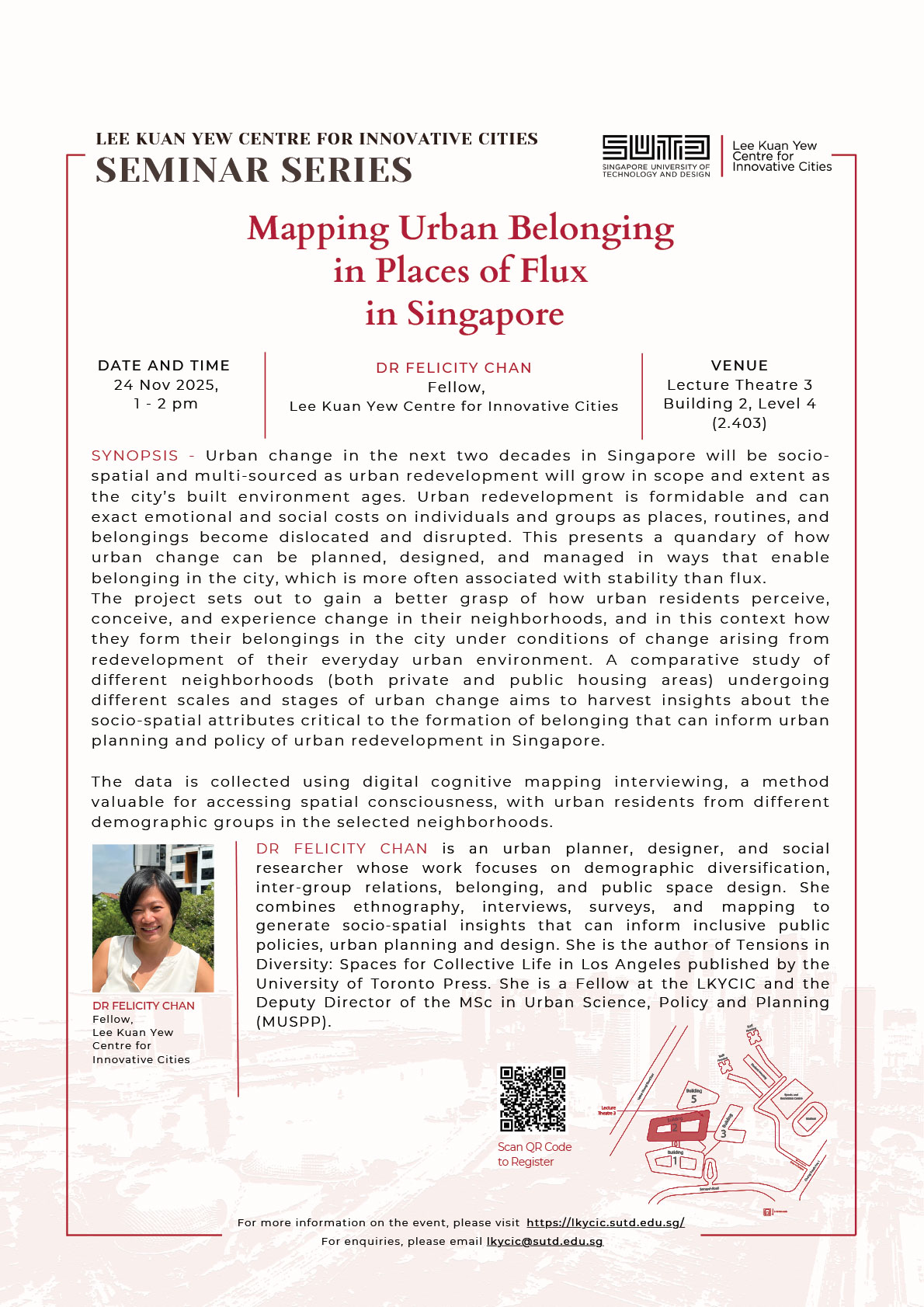
Mapping Urban Belonging in Places of Flux in Singapore
By registering for the event, you consent to the collection and use of your personal information stated on the form by Singapore University of Technology and Design (SUTD), including disclosure to SUTD’s trusted third parties. The personal information collected will be used for the purposes of administering the event registration as well as communicating relevant news and updates about SUTD. You may unsubscribe from any of these correspondences at any point by emailing to lkycic@sutd.edu.sg.
Photography and videography will be conducted during the event. Photos and audio visual recordings may be used by SUTD for event reporting, marketing, publicity, media and social media purposes.
Synopsis
Urban change in the next two decades in Singapore will be socio-spatial and multi-sourced as urban redevelopment will grow in scope and extent as the city’s built environment ages. Urban redevelopment is formidable and can exact emotional and social costs on individuals and groups as places, routines, and belongings become dislocated and disrupted. This presents a quandary of how urban change can be planned, designed, and managed in ways that enable belonging in the city, which is more often associated with stability than flux.
The project sets out to gain a better grasp of how urban residents perceive, conceive, and experience change in their neighborhoods, and in this context how they form their belongings in the city under conditions of change arising from redevelopment of their everyday urban environment. A comparative study of different neighborhoods (both private and public housing areas) undergoing different scales and stages of urban change aims to harvest insights about the socio-spatial attributes critical to the formation of belonging that can inform urban planning and policy of urban redevelopment in Singapore.
The data is collected using digital cognitive mapping interviewing, a method valuable for accessing spatial consciousness, with urban residents from different demographic groups in the selected neighborhoods.
Speaker
Dr Felicity Chan is an urban planner, designer, and social researcher whose work focuses on demographic diversification, inter-group relations, belonging, and public space design. She combines ethnography, interviews, surveys, and mapping to generate socio-spatial insights that can inform inclusive public policies, urban planning and design. She is the author of Tensions in Diversity: Spaces for Collective Life in Los Angeles published by the University of Toronto Press. She is a Fellow at the LKYCIC and the Deputy Director of the MSc in Urban Science, Policy and Planning (MUSPP).
Booking
Thank you for your interest. The registration for this event is now closed as it is fully subscribed.