Synopsis
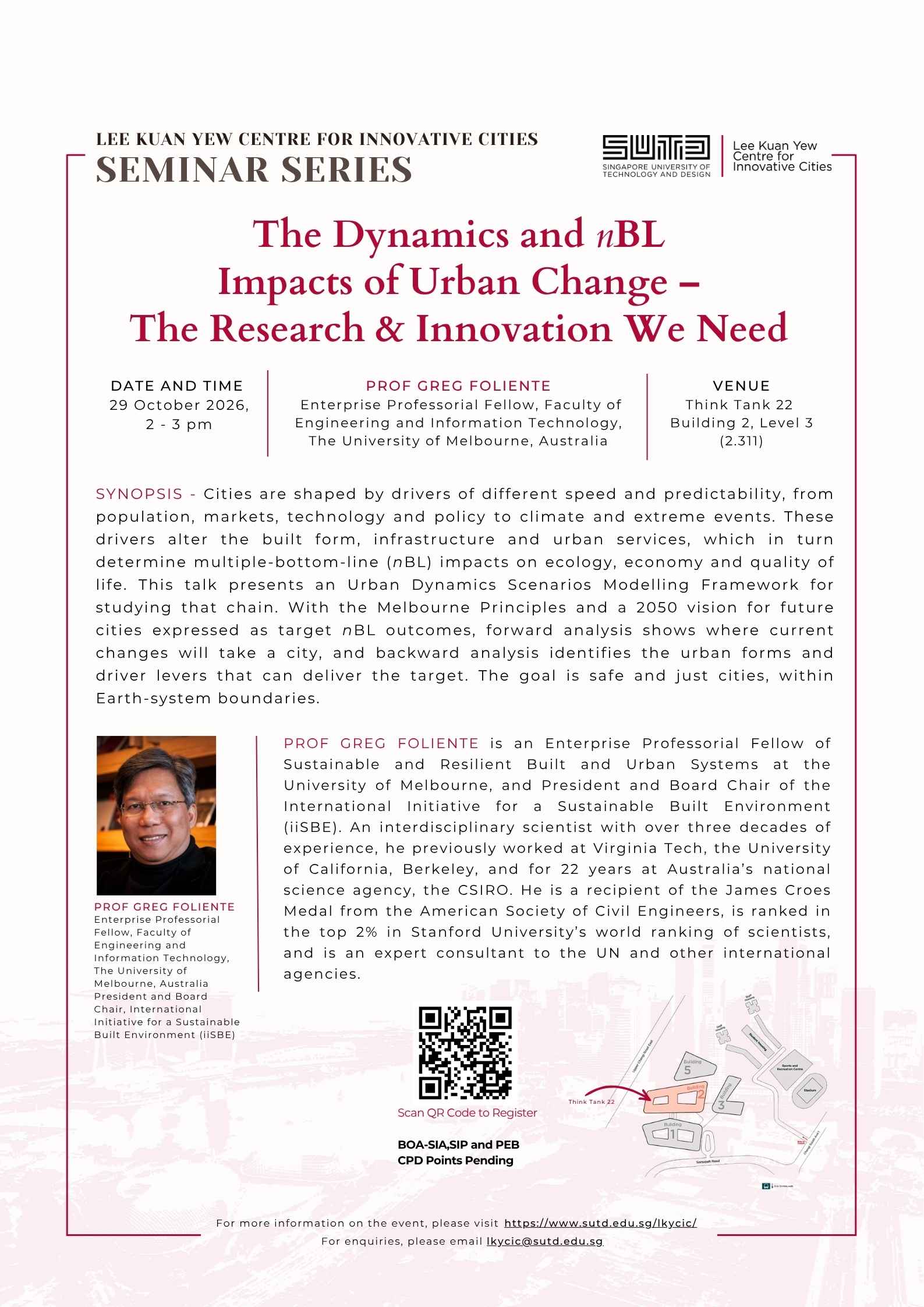
Cities are shaped by drivers of different speed and predictability, from population, markets, technology and policy to climate and extreme events. These drivers alter the built form, infrastructure and urban services, which in turn determine multiple-bottom-line (nBL) impacts on ecology, economy and quality of life. This talk presents an Urban Dynamics Scenarios Modelling Framework for studying that chain. With the Melbourne Principles and a 2050 vision for future cities expressed as target nBL outcomes, forward analysis shows where current changes will take a city, and backward analysis identifies the urban forms and driver levers that can deliver the target. The goal is safe and just cities, within Earth-system boundaries.
Speaker
Prof Greg Foliente is is an Enterprise Professorial Fellow of Sustainable and Resilient Built and Urban Systems at the University of Melbourne, and President and Board Chair of the International Initiative for a Sustainable Built Environment (iiSBE). An interdisciplinary scientist with over three decades of experience, he previously worked at Virginia Tech, the University of California, Berkeley, and for 22 years at Australia’s national science agency, the CSIRO. He is a recipient of the James Croes Medal from the American Society of Civil Engineers, is ranked in the top 2% in Stanford University’s world ranking of scientists, and is an expert consultant to the UN and other international agencies.