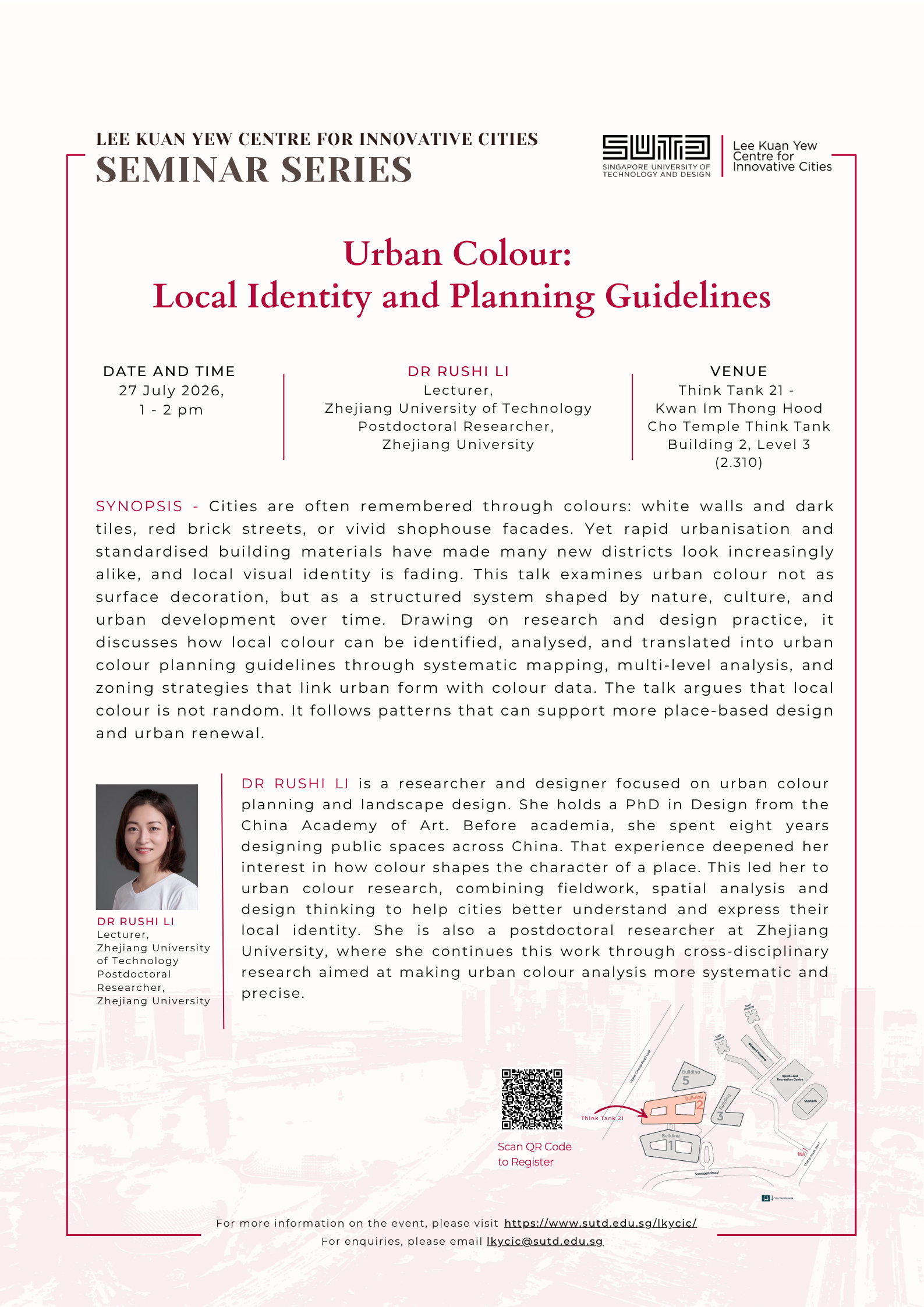
Urban Colour: Local Identity and Planning Guidelines
Synopsis
Cities are often remembered through colours: white walls and dark tiles, red brick streets, or vivid shophouse facades. Yet rapid urbanisation and standardised building materials have made many new districts look increasingly alike, and local visual identity is fading. This talk examines urban colour not as surface decoration, but as a structured system shaped by nature, culture, and urban development over time. Drawing on research and design practice, it discusses how local colour can be identified, analysed, and translated into urban colour planning guidelines through systematic mapping, multi-level analysis, and zoning strategies that link urban form with colour data. The talk argues that local colour is not random. It follows patterns that can support more place-based design and urban renewal.
Speaker
Dr Rushi Li is a researcher and designer focused on urban colour planning and landscape design. She holds a PhD in Design from the China Academy of Art. Before academia, she spent eight years designing public spaces across China. That experience deepened her interest in how colour shapes the character of a place. This led her to urban colour research, combining fieldwork, spatial analysis and design thinking to help cities better understand and express their local identity. She is also a postdoctoral researcher at Zhejiang University, where she continues this work through cross-disciplinary research aimed at making urban colour analysis more systematic and precise.