


Highlights
Staff Achievement: Dr Harvey Neo
Dr Harvey Neo has been appointed Associate Editor, Regional Studies, Regional Science Member of International Editorial Advisory Board, Research Advisory Panel of the Housing Development Board, Associate Editor of Frontiers in Sustainable Cities: Cities in the Global South
Mr Poon King Wang elected Global Partnership on AI – The Future of Work Working Group Member
LKYCIC is pleased to announce that Mr Poon King Wang has been elected as Global Partnership on AI – The Future of Work Working Group Member.
Staff Achievement: Dr Belinda Yuen
Dr Belinda Yuen’s new appointments include Editorial Board of the Royal Town Planning Institute Library Series, Standing Review Board Member to Hong Kong Research Grants Council Humanities and Social Sciences Panel, International Advisory Committee Member to Dutch Research Council and Indonesia Ministry of Research and Technology
Staff Achievement: Prof Cheong Koon Hean
Prof Cheong Koon Hean has been appointed Chairman of the Centre for Liveable Cities Advisory Panel (MND), Board member of Capitaland Pte Ltd, Asia Sustainable Infrastructure Advisory Panel and more.
Staff Achievement: Prof Chan Heng Chee
Prof Chan Heng Chee received appointments on the WEF Global Future Council for Cities of Tomorrow, Council of Urban Initiatives – UN Habitat, LSE Initiatives and UCL Institute for Innovation and Public Purpose, Deputy Chairman of Social Science Research Council and more.
Panel discussion: Smart and sustainable cities – The Way Forward
Prof Cheong Koon Hean is involved in the Kone Experience 2022 Panel discussion: Smart and sustainable cities – the way forward.
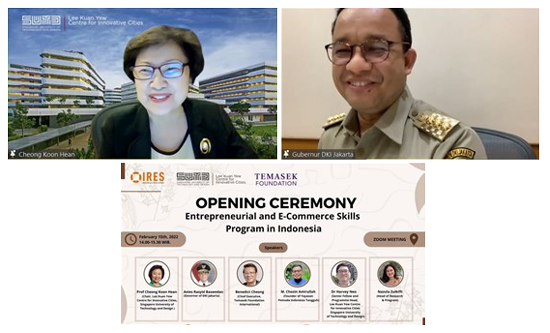
Opening Ceremony of Entrepreneurial and E-Commerce Skills Programme in Indonesia
The Entrepreneurial and E-Commerce Skills Programme in Indonesia is designed by the Lee Kuan Yew Centre for Innovative Cities in collaboration with Indonesia Resilience, and is sponsored by Temasek Foundation International and the Government of DKI Jakarta.
Dr Harvey Neo appointed to Research Advisory Panel of the Housing Development Board
The seven member panel provides inputs to the research agenda of HDB and lends its expertise in various key research projects that are relevant to HDB’s mission and operations.
Dr Harvey Neo appointed Associate Editor of Frontiers in Sustainable Cities: Cities in the Global South
LKYCIC is pleased to announce that Dr Harvey NEO has been appointed the Associate Editor of Frontiers in Sustainable Cities: Cities in the Global South, with effect from 1 April 2021. In addition, he has also been appointed to the editorial boards of Geoforum (with effect from 30 June 2021) and Progress in Environmental Geography (with effect from 1 June 2021).

Striking a Chord: Investigating Singapore’s Beloved National Day Songs
Tan Yin Xi and Samuel Chng examine whether a “reminiscence bump” can help us understand the enduring popularity of some of Singapore’s National Day songs.