If You Can Solve Problems, Can You Innovate?
Shin Min Daily News, 会解题,就会创新吗?
By Professor Yow Wei Quin, Head of Humanities, Arts and Social Sciences
(Translation)
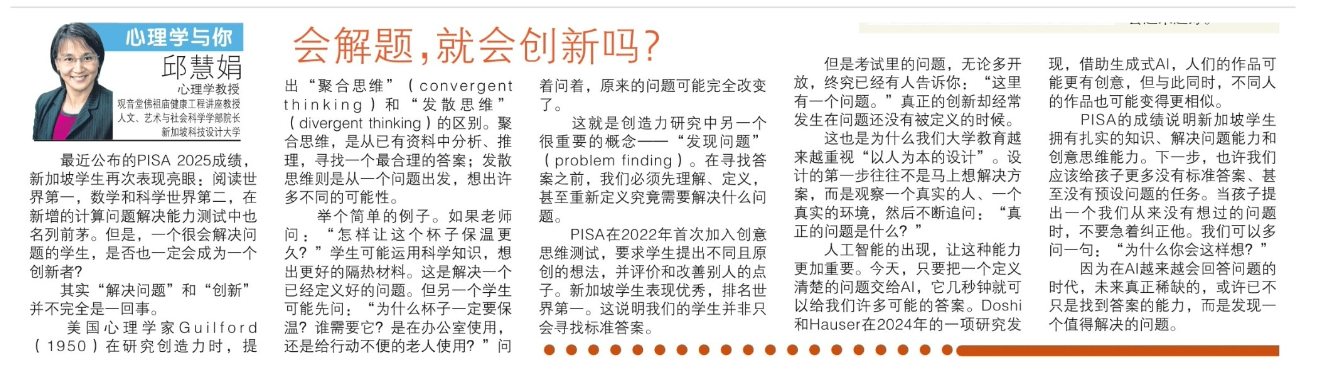
The recently released PISA 2025 results show that Singaporean students have once again performed exceptionally well. They ranked first in reading, second in mathematics and science, and were among the world’s top performers in the newly introduced assessment of creative thinking. However, does being highly capable at solving problems necessarily mean that a person is also capable of innovation?
Actually, “problem-solving” and “innovation” are not exactly the same thing.
American psychologist J. P. Guilford (1950) proposed two modes of thinking in his research on creativity: “convergent thinking” and “divergent thinking”. Convergent thinking involves analysing existing information, reasoning and identifying the most logical answer. Divergent thinking, on the other hand, involves starting from the same point and exploring multiple different possibilities.
Let us consider a simple example. If a teacher asks, “How can we keep this glass of water warm for a longer period?”, students might apply scientific knowledge and suggest using better insulating materials. This is an example of solving a well-defined problem. However, if a student asks instead, “Why must the water be kept warm? Who needs it? Is it for office workers or elderly people with limited mobility?”, the original problem may be completely transformed.
This brings us to another important concept in creativity research: “problem finding”. Before searching for solutions, we must recognise, define and sometimes even redefine what the problem is that truly needs to be solved.
In the 2022 PISA assessment, Singapore ranked first globally in creative thinking. To perform well in such assessments, students must not only have the ability to analyse and solve problems, but also be able to identify different perspectives. Singaporean students have demonstrated outstanding performance and deserve recognition. This shows that our students are not simply good at applying examination techniques to produce standard answers.
However, the question worth reflecting on is this: regardless of how many points students score, we must remember what these scores ultimately represent. The real process of innovation often begins before a problem has even been defined.
This is also why our universities are increasingly emphasising “human-centred design”. Design thinking does not merely involve finding solutions to a problem that has already been presented. Rather, it begins with observing real people and understanding their environments, before continuously asking: “What is the real problem?”
The emergence of artificial intelligence has made this capability even more important. Today, as long as we give AI a clearly defined problem, it can already help us carry out many tasks that previously required considerable effort. Research conducted in 2024 by Doshi and Hauser found that, with the assistance of generative AI, people’s creative work may become more innovative, but the works produced by different individuals may also become more similar.
PISA results show that Singaporean students possess solid knowledge, problem-solving abilities and creative thinking skills. The next step may be to encourage students to ask more questions that do not have standard answers, and even to challenge the tasks they have been given.
When children raise questions that we have never considered, we should not be too quick to correct them. Instead, we can ask: “Why do you think so?”
As AI becomes increasingly capable of answering questions, what may become truly scarce in the future is no longer the ability to find answers, but the ability to identify a question that is genuinely worth solving.