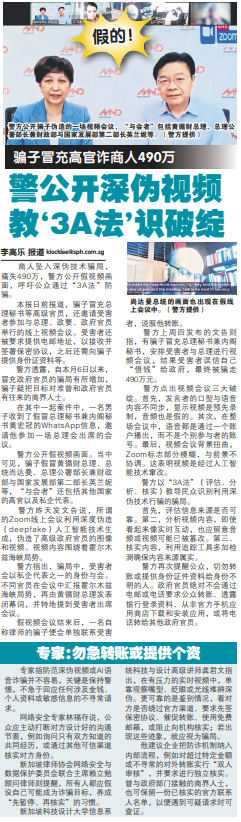
Police release deepfake video footage and teach public the “3A Method” to spot scams
Shin Min Daily News, 警公开深伪视频 教‘3A法’识破绽
(Summarised translation)
After a businessman lost S$4.9 million in a deepfake scam, police released footage of the fake video conference and urged the public to use the “3A Method” to avoid falling victim to similar schemes.
As previously reported, scammers impersonated senior officials including the Prime Minister’s secretary and invited victims to online video meetings supposedly involving the Prime Minister, political office holders, and government officials. Victims were asked to provide email addresses to receive and sign confidentiality agreements before submitting identification details to the scammers.
The police share the “3A Method” – Assess, Analyse, and Authenticate – to help the public identify scams involving deepfake technology. First, people should assess whether the source of the information is trustworthy. Second, they should analyse the video content carefully, as even interactions that appear to be live may contain manipulated audio or visuals. Third, they should authenticate the content by using tracking and verification tools to ensure that the source of the information is genuine.
Experts: Do not rush to transfer money or share personal information
Experts say that preventing scams involving deepfake videos or AI-generated voices is not easy. The key is to remain vigilant and avoid responding hastily to unusual requests involving money, personal data, or sensitive information.
Dr Victor Keong, Senior Lecturer in Information Systems Technology and Design at the Singapore University of Technology and Design, pointed out that in high-pressure live video situations, it is difficult to identify deepfakes simply by observing lip movements, blinking, or lighting.
He said a more reliable approach is to assess the overall situation. Warning signs include attempts to bypass official channels, requests to sign confidentiality agreements before discussions, pressure to transfer money urgently, use of free email services, or efforts to stop victims from independently verifying information with institutions. If such signs appear, the situation should be treated as a scam.
He also suggested that companies incorporate anti-scam measures into internal processes. For example, external fund transfers above a certain amount or unusual transactions should require dual approval and independent verification. Businesspeople who frequently interact with government agencies should also maintain a verified list of official contacts to check suspicious requests against.