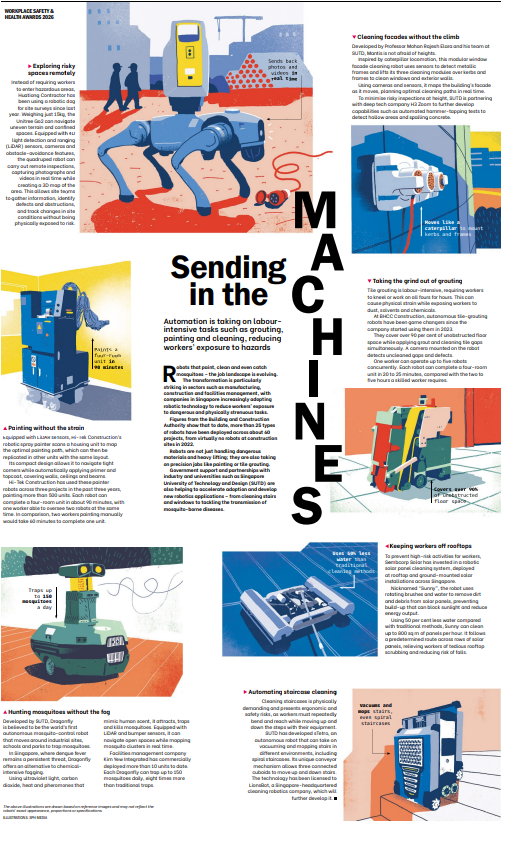
Sending in the machines
The Straits Times, Sending in the machines
Automation is taking on labour intensive tasks such as grouting, painting and cleaning, reducing workers’ exposure to hazards
Robots that paint, clean and even catch mosquitoes – the job landscape is evolving. The transformation is particularly striking in sectors such as manufacturing, construction and facilities management, with companies in Singapore increasingly adopting robotic technology to reduce workers’ exposure to dangerous and physically strenuous tasks.
Figures from the Building and Construction Authority show that to date, more than 25 types of robots have been deployed across about 60 projects, from virtually no robots at construction sites in 2022.
Robots are not just handling dangerous materials and heavy lifting; they are also taking on precision jobs like painting or tile grouting. Government support and partnerships with
industry and universities such as Singapore University of Technology and Design (SUTD) are also helping to accelerate adoption and develop new robotics applications – from cleaning stairs and windows to tackling the transmission of mosquito-borne diseases.
Exploring risky spaces remotely
Instead of requiring workers to enter hazardous areas, Huationg Contractor has been using a robotic dog for site surveys since last year. Weighing just 15kg, the Unitree Go2 can navigate uneven terrain and confined spaces. Equipped with 4D light detection and ranging (LiDAR) sensors, cameras and obstacle-avoidance features, the quadruped robot can carry out remote inspections, capturing photographs and videos in real time while
creating a 3D map of the area. This allows site teams to gather information, identify defects and obstructions, and track changes in site conditions without being physically exposed to risk.
Cleaning facades without the climb
Developed by Professor Mohan Rajesh Elara and his team at SUTD, Mantis is not afraid of heights.
Inspired by caterpillar locomotion, this modular window facade cleaning robot uses sensors to detect metallic frames and lifts its three cleaning modules over kerbs and frames to clean windows and exterior walls.
Using cameras and sensors, it maps the building’s facade as it moves, planning optimal cleaning paths in real time.
To minimise risky inspections at height, SUTD is partnering with deep tech company H3 Zoom to further develop capabilities such as automated hammer-tapping tests to detect hollow areas and spalling concrete.
Taking the grind out of grouting
Tile grouting is labour-intensive, requiring workers to kneel or work on all fours for hours. This can cause physical strain while exposing workers to dust, solvents and chemicals.
At BHCC Construction, autonomous tile-grouting robots have been game changers since the company started using them in 2023.
They cover over 90 per cent of unobstructed floor space while applying grout and cleaning tile gaps simultaneously. A camera mounted on the robot detects uncleaned gaps and defects.
One worker can operate up to five robots concurrently. Each robot can complete a four-room unit in 20 to 25 minutes, compared with the two to five hours a skilled worker requires.
Painting without the strain
Equipped with LiDAR sensors, Hi-Tek Construction’s robotic spray painter scans a housing unit to map the optimal painting path, which can then be replicated in other units with the same layout.
Its compact design allows it to navigate tight corners while automatically applying primer and topcoat, covering walls, ceilings and beams.
Hi-Tek Construction has used these painter robots across three projects in the past three years, painting more than 500 units. Each robot can complete a four-room unit in about 90 minutes, with one worker able to oversee two robots at the same time. In comparison, two workers painting manually would take 60 minutes to complete one unit.
Keeping workers off rooftops
To prevent high-risk activities for workers, Sembcorp Solar has invested in a robotic solar panel cleaning system, deployed at rooftop and ground-mounted solar installations across Singapore.
Nicknamed “Sunny”, the robot uses rotating brushes and water to remove dirt and debris from solar panels, preventing build-up that can block sunlight and reduce energy output.
Using 50 per cent less water compared with traditional methods, Sunny can clean up to 800 sq m of panels per hour. It follows a predetermined route across rows of solar panels, relieving workers of tedious rooftop scrubbing and reducing risk of falls.
Hunting mosquitoes without the fog
Developed by SUTD, Dragonfly is believed to be the world’s first autonomous mosquito-control robot that moves around industrial sites, schools and parks to trap mosquitoes.
In Singapore, where dengue fever remains a persistent threat, Dragonfly offers an alternative to chemical-intensive fogging.
Using ultraviolet light, carbon dioxide, heat and pheromones that mimic human scent, it attracts, traps and kills mosquitoes. Equipped with LiDAR and bumper sensors, it can navigate open spaces while mapping mosquito clusters in real time.
Facilities management company Kim Yew Integrated has commercially deployed more than 10 units to date. Each Dragonfly can trap up to 150 mosquitoes daily, eight times more than traditional traps.
Automating staircase cleaning
Cleaning staircases is physically demanding and presents ergonomic and safety risks, as workers must repeatedly bend and reach while moving up and down the steps with their equipment. SUTD has developed sTetro, an autonomous robot that can take on vacuuming and mopping stairs in different environments, including spiral staircases. Its unique conveyor mechanism allows three connected cuboids to move up and down stairs. The technology has been licensed to LionsBot, a Singapore-headquartered cleaning robotics company, which will further develop it.