SUTD Graduate Determined to Help At-Risk Youth Find Direction in Life
Berita Harian, Lulusan SUTD tekad bantu belia berisiko temui arah hidup
(Translation)
While many university students focus on pursuing academic qualifications, Mr Muhammad Irfan Djuanda has chosen to devote a significant portion of his time to serving the community.
Through the Youth Corps Leaders Programme (YCLP), a nine- or 12-month community leadership development programme for youths aged 17 to 25, participants are required to plan and implement a community service project to help those in need.
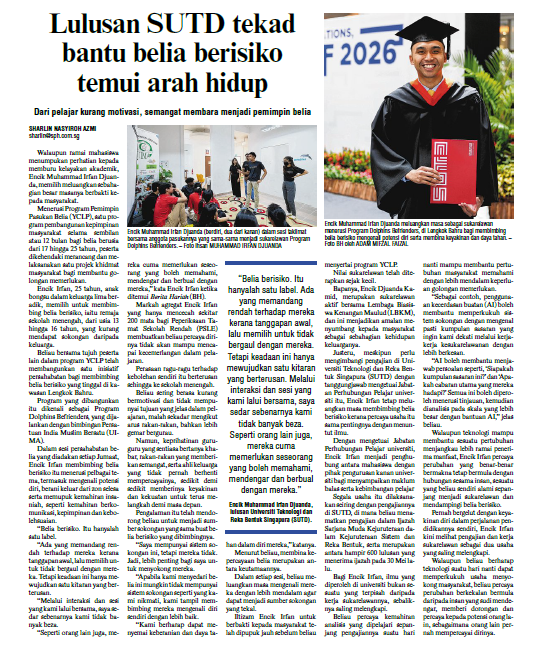
Mr Irfan, 25, the youngest of five siblings, chose to mentor at-risk youths—secondary school students aged 13 to 16 who receive little support from their families. Together with seven other YCLP participants, he developed a befriending initiative to mentor at-risk youths living in the Lengkok Bahru area. The programme, known as the Dolphins Befrienders Programme, is conducted under the guidance of the United Indian Muslim Association (UIMA).
During the weekly befriending sessions held every Friday, Mr Irfan guides the youths through various themes, including recognising their own potential, stepping out of their comfort zones, and developing soft skills such as communication, leadership and adaptability.
“At-risk youth is only a label,” said Mr Irfan. “Some people look down on them because of their first impressions and choose not to associate with them. But this only creates a cycle that continues.
“Through the interactions and sessions we have shared, I realised that we are actually not very different. Like everyone else, they simply need someone who can understand them, listen to them and talk to them.”
Mr Irfan’s aggregate score of around 200 points in the Primary School Leaving Examination (PSLE) made him believe that he would never be able to excel academically. That self-doubt continued into secondary school.
He often felt unmotivated and lacked a clear purpose in his studies, merely going along with his friends and preferring to joke around. However, teachers who consistently checked on him, friends who encouraged him and family members who never stopped believing in him gradually gave him the confidence and strength to keep moving forward.
That experience inspired him to become the same source of support for the at-risk youths he now mentors.
“I had this support system, but they did not. So it is even more important for me to support them,” he said.
“When we realised that these youths might not have the same support system that we enjoyed, we stepped forward to help them understand themselves better. We hope to nurture courage and resilience in them.”
According to him, building trust with the youths is among his highest priorities. In every session, he spends time getting to know them more deeply so that he can become a consistent source of support.
Mr Irfan’s commitment to serving the community was cultivated long before he joined YCLP. Volunteerism was instilled in him from a young age. His father, Mr Djuanda Kamid, is an active volunteer with the Prophet Muhammad Memorial Scholarship Fund Board (LBKM), making community service part of family life.
Despite balancing his studies at the Singapore University of Technology and Design (SUTD) with his responsibilities as Head of the university’s Student Relations Department, Mr Irfan continued mentoring at-risk youths because he believes the effort is just as important as pursuing an education.
As Head of the Student Relations Department, he serves as the bridge between students and the university’s senior management, conveying students’ feedback and concerns. He completed these responsibilities while pursuing his Bachelor of Engineering in Engineering Systems and Design at SUTD, graduating as one of nearly 600 students who received their degrees on 30 May.
For Mr Irfan, the knowledge he gained at university is not separate from his volunteer work; rather, the two complement each other. He believes the analytical skills acquired during his studies will one day help community organisations better understand the needs of vulnerable groups.
“For example, the use of artificial intelligence (AI) can help strengthen support systems by identifying the target groups we want to reach through volunteer work more effectively,” he said. “AI can help answer questions such as, ‘Who are these target groups?’ and ‘What are the main challenges they face?’ This information can be gathered through surveys and analysed on a much larger scale with the help of AI,” he explained.
Although technology can help organisations reach more beneficiaries, Mr Irfan believes truly meaningful change still begins with human relationships, something he himself experienced while volunteering and working with at-risk youths.
Having once struggled with self-confidence during his own educational journey, Mr Irfan now sees education and volunteer work as two efforts that complement each other.
Although he hopes technology will one day strengthen efforts to support the community, he believes lasting change begins with people who are willing to listen, encourage and believe in the potential of others, just as others once believed in him.