Transforming Education with AI
Shin Min Daily News, AI改变教育
By Professor Yow Wei Quin, Head of Humanities, Arts and Social Sciences
(Translation)
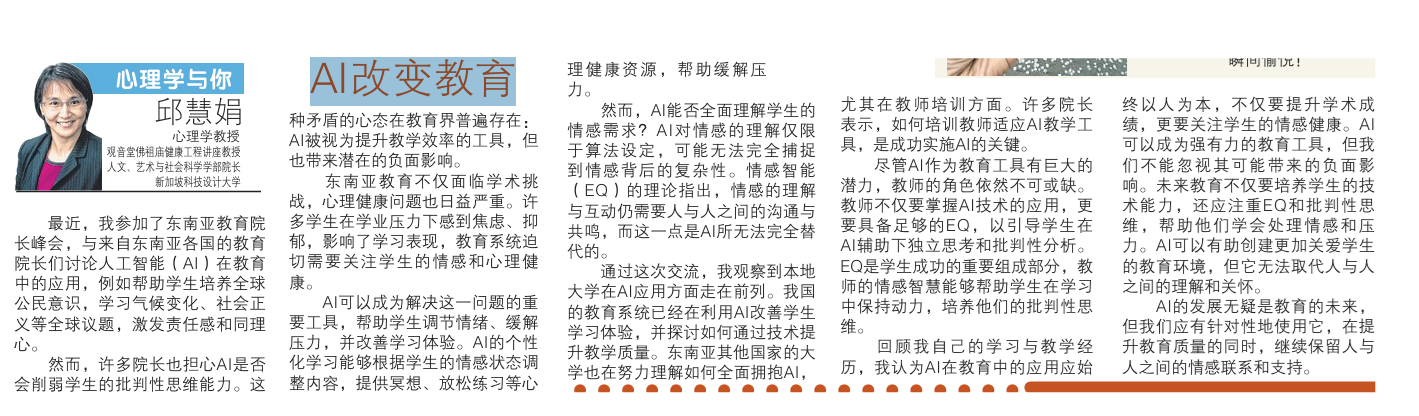
At a recent Southeast Asia education deans’ summit, education leaders across the region discussed the use of artificial intelligence (AI) in education, including its potential to help students develop global citizenship by engaging with issues such as climate change and social justice, while fostering responsibility and empathy. However, many deans also expressed concern that AI may weaken students’ critical thinking abilities, reflecting a broader tension in education where AI is seen both as a tool to enhance teaching efficiency and as a source of potential unintended consequences.
Beyond academic considerations, Southeast Asia is also facing growing mental health challenges among students, with many experiencing anxiety and depression due to academic pressure, which affects learning outcomes. AI could help address this by supporting personalised learning and offering emotional wellbeing tools such as stress relief and relaxation exercises, but its ability to truly understand human emotions remains limited, as emotional intelligence still depends on human interaction and empathy. While universities in the region are increasingly adopting AI—particularly in improving learning and teacher training—educators remain essential in guiding students’ critical thinking and emotional development. Ultimately, AI in education should remain human-centred, enhancing learning while preserving emotional connection, empathy, and the irreplaceable role of teachers.