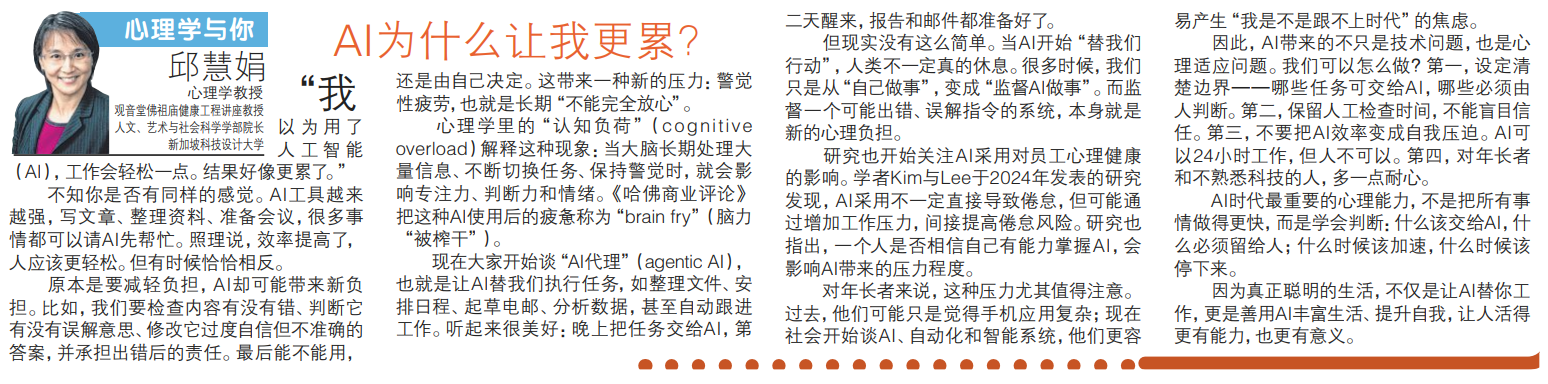
Why Is AI Making Me More Tired?
Shin Min Daily News, AI为什么让我更累?
By Professor Yow Wei Quin, Head of Humanities, Arts and Social Sciences
(Translation)
“I thought using artificial intelligence (AI) would make work easier. But somehow, I feel even more exhausted.”
You may have felt the same way. AI tools are becoming increasingly powerful. They can help draft articles, organise information, prepare meetings, and handle many other tasks. In theory, greater efficiency should make life easier. Yet sometimes, the opposite happens.
AI was meant to reduce our workload, but it may also create new burdens. We now have to check whether the content is accurate, determine whether the AI misunderstood the context, correct answers that sound confident but are inaccurate, and bear responsibility if mistakes occur. In the end, humans still decide whether the output can be used. This creates a new kind of stress: vigilance fatigue — the constant feeling that we can never fully let our guard down.
The psychological concept of “cognitive overload” can be used to explain this phenomenon. When the brain continuously processes large amounts of information, constantly switches between tasks, and remains alert for long periods, it affects concentration, judgement, and emotions. Harvard Business Review has described this post-AI exhaustion as “brain fry”.
Today, people are increasingly talking about “agentic AI” — systems that can perform tasks on our behalf, such as organising documents, scheduling meetings, drafting emails, analysing data, and even following up on work automatically. It sounds ideal: hand tasks over to AI at night, and wake up the next morning with reports and emails already prepared.
But reality is not so simple. When AI starts “acting for us”, humans do not necessarily get to rest. In many cases, we simply shift from “doing the work ourselves” to “supervising AI doing the work”. And monitoring a system that may make mistakes or misunderstand instructions becomes a new psychological burden in itself.
Researchers have also begun studying how AI adoption affects employees’ mental health. A 2024 study by Kim and Lee found that while AI adoption may not directly cause burnout, it can indirectly increase burnout risk by increasing workplace stress. The study also noted that a person’s confidence in their ability to master AI affects how stressful AI becomes for them.
For older adults, this pressure deserves particular attention. In the past, they may simply have found smartphone apps complicated. Now, as society increasingly discusses AI, automation, and intelligent systems, they may feel anxious about whether they are falling behind the times.
As such, AI brings not only technological challenges, but also psychological adaptation challenges. What can we do?
First, set clear boundaries — decide which tasks can be delegated to AI and which require human judgement. Second, preserve time for human review and avoid blindly trusting AI outputs. Third, do not turn AI-driven efficiency into self-imposed pressure. AI can work 24 hours a day; humans cannot. Fourth, show more patience toward older adults and those less familiar with technology.
In the AI era, the most important psychological skill is not doing everything faster, but learning to judge wisely: what should be entrusted to AI, what must remain in human hands, when to accelerate, and when to slow down.
Because truly intelligent living is not simply about getting AI to work for you. It is about using AI meaningfully to enrich life, improve ourselves, and help people live with greater capability and purpose.