
Singapore University of Technology and Design (SUTD)
Master of Science in Technology and Design (Artificial Intelligence)
Programme schedule
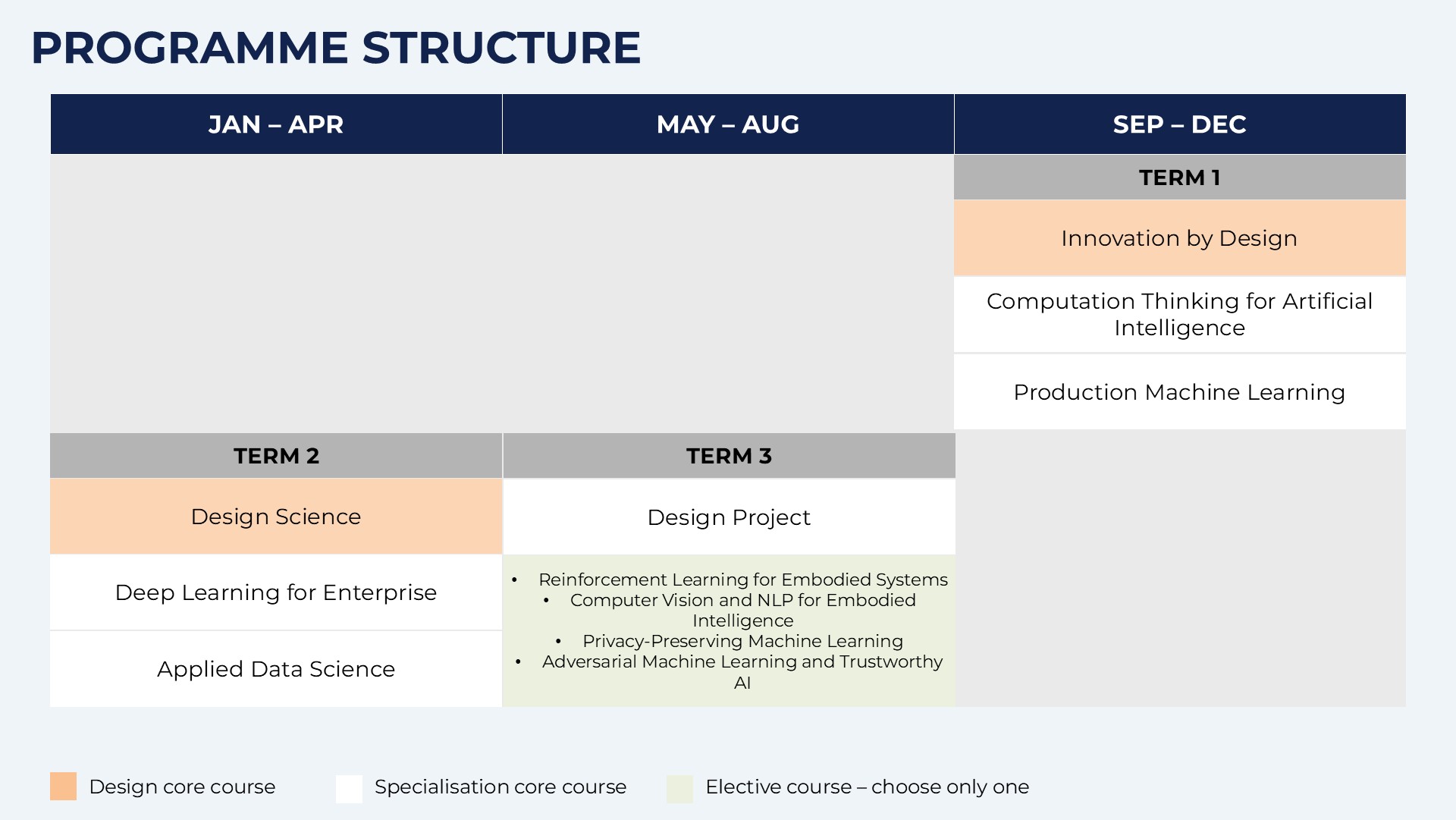
The MTD (Artificial Intelligence) is a one-year full-time coursework-based Master programme. It comprises eight courses (96 credits)—two core design courses, five specialised courses (including one design project) and one elective course chosen from four options, organised as follows:
Course descriptions
Innovation by Design (12 credit points)
The focus of this course is the integration of marketing, design, engineering and manufacturing functions in creating and developing a new product, system or service. The course will go through the different phases of designing a new product, system or service and will focus on some of the critical success factors for new product development, with an early emphasis on design thinking. The overall framework of this programme and its accelerated pace will be set by this introductory course, where students will be given a design challenge to complete during the term.
Computation Thinking for Artificial Intelligence (12 credit points)
This course equips students with important computation thinking and algorithmic concepts for artificial intelligence (AI). The course covers important software skills, algorithms, algorithmic paradigms, and data structures that can be used to solve computational problems. Emphasis is placed on understanding why algorithms work and their critical roles in modern AI, and how to analyse the complexity of algorithms. Students will learn the underlying thought process on how to design their own algorithms, including how to use suitable data structures and techniques such as dynamic programming to design algorithms that are efficient.
Production Machine Learning (12 credit points)
This course provides a comprehensive introduction to the fundamental concepts and algorithms of machine learning, emphasising both theoretical foundations and practical applications. Students will explore key supervised and unsupervised learning techniques, including regression, classification, clustering, dimensionality reduction, and ensemble methods. The course also covers essential optimisation algorithms, model evaluation, and selection strategies. Through applied projects and case studies, students will gain hands-on experience implementing and refining machine learning models for real-world problems. By the end of the course, you will develop a strong foundation to advance into more specialised areas of artificial intelligence and data science.
Design Science (12 credit points)
This course will introduce students to design science. Many design principles and methods are reviewed, applied and analysed. Students will learn to make connections between design science and other fields in, for example, engineering and how principles in design science can be used to advance these fields. The class will cover a broad set of design methods such as customer needs analysis, methods in creativity, functional modelling, design for X, design for testing and verification.
Deep Learning for Enterprise (12 credit points)
This course builds on foundational machine learning knowledge to introduce the core principles and applications of deep learning. Students will gain hands-on experience implementing, training, and optimising deep learning architectures such as CNNs, RNNs, and transformers using frameworks like PyTorch. The course emphasises practical skills in data handling, model design, and GPU-based training, while also exploring advanced topics including transfer learning, GANs, and autoencoders. Through project-based learning, students will apply skills to real-world tasks in vision, language, and sequence modelling, be prepared for specialised AI courses in later terms.
Applied Data Science (12 credit points)
This course offers a practical introduction to the core principles and tools of data science, emphasising end-to-end project development. Students will learn how to collect, preprocess, and analyse data using modern machine learning methods and computational frameworks. The course covers essential topics such as data management, feature engineering, and distributed processing for large-scale datasets. Through hands-on projects, students will apply these techniques to solve real-world problems, building a strong foundation for advanced work in AI and intelligent systems.
Design Project (12 credit points)
This capstone design project provides students with hands-on experience applying artificial intelligence, machine learning, and deep learning to solve real-world problems. Working in small teams under the guidance of a faculty advisor, students will identify, design, and implement a project that integrates technical innovation with human-centred design principles. The project encourages creativity, collaboration, and critical thinking, allowing students to synthesise knowledge from previous courses while addressing meaningful challenges at the intersection of AI and design.