Singapore University of Technology and Design (SUTD)
Master of Science in Technology and Design (Optics and Photonics)
Programme schedule
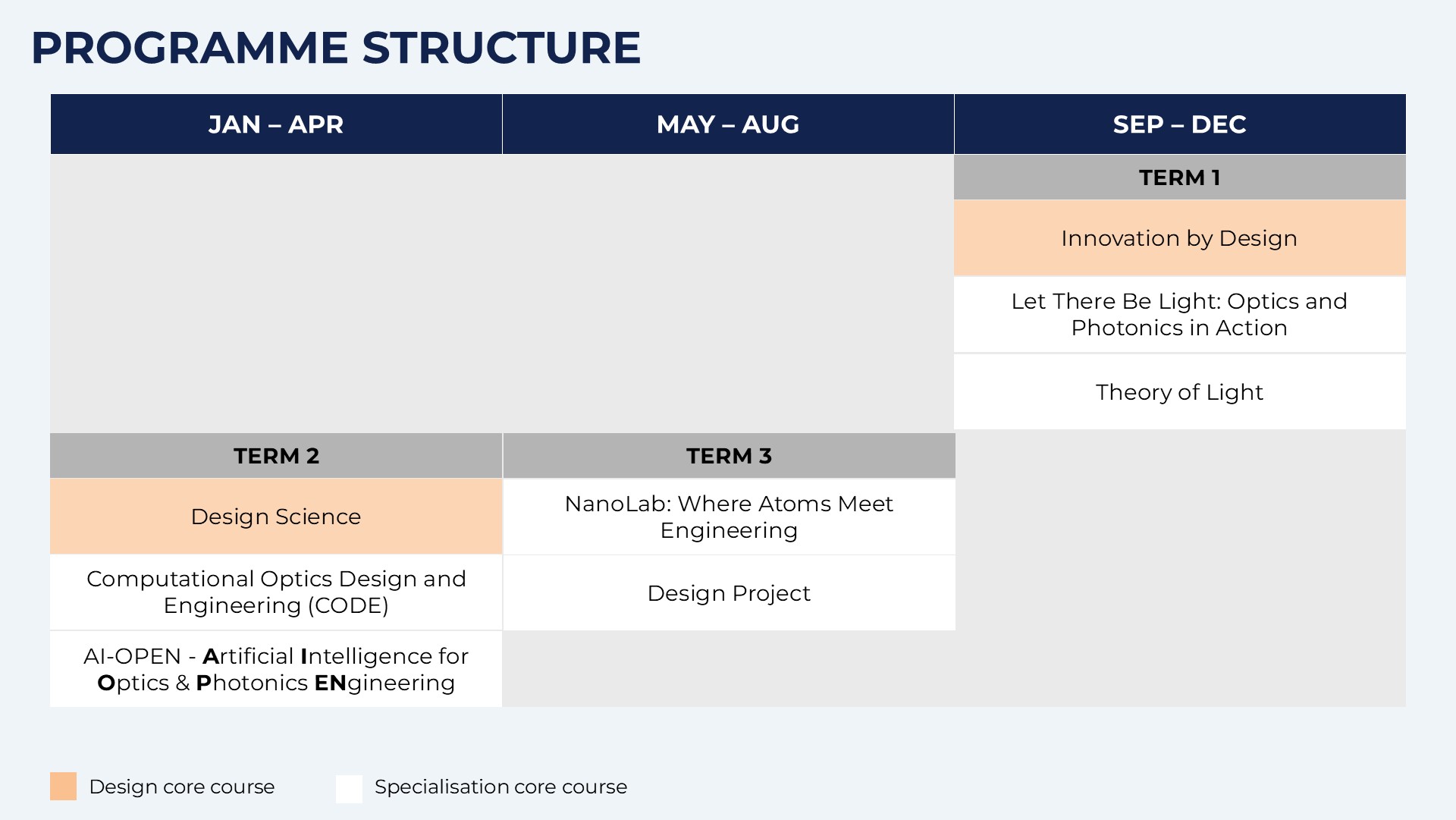
The MTD (Optics and Photonics) is a one-year full-time coursework-based Master programme. It comprises eight courses (96 credits): two core design courses and six specialised courses, organised as follows:
Course descriptions
Innovation by Design (12 credit points)
The focus of this course is the integration of marketing, design, engineering and manufacturing functions in creating and developing a new product, system or service. The course will go through the different phases of designing a new product, system or service using the four Ds of the four-phase Design Innovation Cycle of “Discover-Define-Develop-Deliver”. The course will focus on some of the critical success factors for new product development, with an early emphasis on design thinking. Students will be given a design challenge to complete.
Let There Be Light: Optics and Photonics in Action (12 credit points)
This course is an entry point to the field of optics and photonics. It is designed to provide students with a foundational understanding of how light-based technologies are driving transformative change across industries. Through a contextual exploration of global megatrends, students will examine the pivotal role of optics and photonics in areas such as quantum computing, AI acceleration, high-speed data communications, imaging, illumination and autonomous sensing. The course will highlight real-world applications including integrated quantum photonics, photonic interconnects for AI hardware, LiDAR for autonomous vehicles, and metasurface-enabled optics.
Theory of Light (12 credit points)
Theory of Light provides a rigorous foundation in electromagnetic theory and its applications to modern photonics and optical systems. Students will learn wave propagation, polarisation, and beam optics before advancing to guided-wave phenomena, anisotropic media, and optical resonators. The course also covers advanced topics, including scattering, diffraction, photonic crystals, nonlinear effects, and emerging areas such as metamaterials, plasmonics, and topological photonics. Emphasis is placed on analytical modelling and computational techniques (FDTD, FEM) to introduce and equip students with the skills needed to design, analyse, and innovate in photonic and optical device research.
Design Science (12 credit points)
This course introduces students to design science where many design principles and methods will be reviewed, applied and analysed. Students will learn to make connections between design science and other fields, such as engineering, and how principles in design science can be used to advance these fields. The class will cover a broad set of design methods such as customer needs analysis, methods in creativity, functional modelling, design for X and design for testing and verification.
Computational Optics Design and Engineering (CODE) (12 credit points)
CODE trains students to design, simulate, and optimise modern optical and photonic systems using computational tools. Blending classical and wave optics with AI-driven design, this course prepares students for real-world applications in imaging, photonics, AR/VR, and optical engineering. Students will gain practical experience, e.g. using MATLAB for optical modelling, Lumerical FDTD for full-wave electromagnetic simulation, and deep learning for data-driven and inverse design of components like metasurfaces, lenses, and integrated photonic devices.
AI-OPEN – Artificial Intelligence for Optics & Photonics ENgineering (12 credit points)
The complexity and data-driven demands of the fields that optics and photonics engineering is playing in increasingly require advanced AI methods. This course bridges the gap between optical science and AI, equipping students with practical skills in applying machine learning to photonic device design, optical communications, imaging, and large-scale data analysis. Students will learn to deploy AI-driven optimisation, integrate AI with traditional physics-based modelling, and evaluate the effectiveness and limitations of AI approaches in photonics, preparing them for competitive roles in research and industry.
NanoLab: Where Atoms Meet Engineering (12 credit points)
This is a course that introduces students to the “unsung hero” in enabling advances in modern day hardware including optics and photonics, namely nanofabrication and nanometrology. This course provides a comprehensive foundation in the concepts and practice of fabricating nanoscale photonic devices. Crucially, participants will gain access to the SUTD cleanroom and metrology labs for hands-on training. This experience allows participants to deeply appreciate the complexity of cutting-edge tools, equipment and processes used in making and characterising an actual device. Participants will master the core techniques in nanofabrication including thin film deposition, advanced lithography (optical, electron beam, nanoimprint), and precise etching methods. These skills will be applied in fabricating and test a device component, which is relevant for Design Project in the same term.
Design Project (12 credit points)
Mentored by an SUTD faculty member, students in groups will work on a semester-long optics and photonics design project.