

Master of Science in Technology and Design (Robotics & Automation)
Applications for 2026 are closed. See you in 2027.
Singapore University of Technology and Design (SUTD)
Master of Science in Technology and Design (Robotics & Automation)
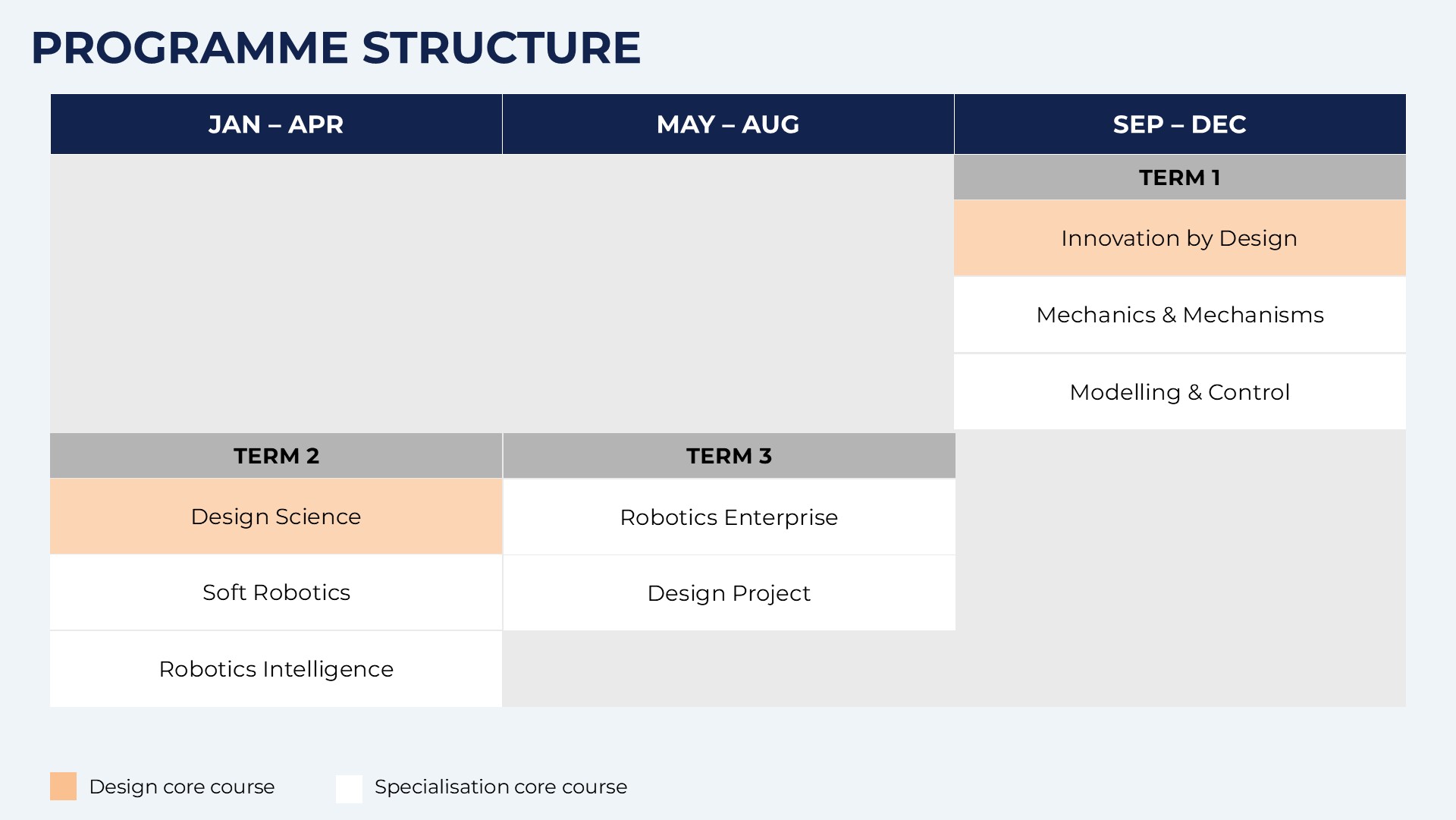
Programme schedule
The MTD (Robotics & Automation) is a one-year full-time coursework-based Master programme. It comprises eight courses (96 credits)—two core design courses, five specialised courses, and one design project.
Course descriptions
Innovation by Design (12 credit points)
The focus of this course is the integration of marketing, design, engineering and manufacturing functions in creating and developing a new product, system or service. The course will go through the different phases of designing a new product, system or service using the four Ds of the four-phase Design Innovation Cycle of “Discover-Define-Develop-Deliver”. The course will focus on some of the critical success factors for new product development, with an early emphasis on design thinking. Students will be given a design challenge to complete.
Mechanics & Mechanisms (12 credit points)
This course focuses on the fundamental engineering principles of kinematics and kinetics for design of mechanisms. These include kinematics, dynamics of three-dimensional rigid motions, and how they can be applied for synthesising and analysing serial and parallel planar, spherical, and spatial linkage mechanisms using computer-aided design tools.
Modelling & Control (12 credit points)
Modelling & Control delves into the intricate realm of dynamic systems and their behaviour over time. From understanding the fundamental principles of feedback loops to exploring the complexities of interconnected components, students embark on a journey to grasp the dynamics that govern various engineering systems. The course not only equips students with analytical tools like differential equations, state-space and Laplace transforms, but also encourages the application of these tools to solve real-world engineering problems. As students navigate through this hands-on course, they gain valuable insights into modelling, simulation, and control strategies, fostering a holistic understanding of dynamic systems. This course is not just about equations; it’s about deciphering the dance of variables and interactions that define the dynamic nature of engineering systems, making it an essential and intellectually stimulating experience for aspiring engineers.
Design Science (12 credit points)
This course introduces students to design science where many design principles and methods will be reviewed, applied and analysed. Students will learn to make connections between design science and other fields, such as engineering, and how principles in design science can be used to advance these fields. The class will cover a broad set of design methods such as customer needs analysis, methods in creativity, functional modelling, design for X and design for testing and verification.
Soft Robotics (12 credit points)
Encompassing theoretical foundations and hands-on experimentation, this course focuses on specialised design, modelling, and fabrication techniques tailored to soft robots. Students will be introduced to various case studies on sensing, actuation, grasping, and locomotion, as well as standard approaches for performance characterisation. The cornerstone of the course is a project where students, working individually or in groups, will be provided with design and fabrication resources and tasked to develop a novel technology related to Soft Robotics.
Robotics Intelligence (12 credit points)
Robots are becoming an integral part of our lives, and it is important to enable these intelligent machines with the necessary capabilities. The objective of this course is to provide the fundamentals to develop mobile robots. Topics covered include mobile robot locomotion, kinematics, localisation and mapping and perception. On top of the regular lectures, students will build working mobile robotic systems in a group-based project using ROS2.
Robotics Enterprise (12 credit points)
The Robotics Enterprise course is designed to offer a comprehensive understanding of theory and skills that will empower aspiring robotics entrepreneurs, engineers and designers wanting to work for robotics start-ups, and managers leading robotics business units within large organisations. Over the duration of the course, students will collaborate as a team to develop and validate a robotics business idea, which will be pitched at the end of the semester. Each week will focus on a targeted topic delivered through combinations of interactive lectures, skills studios, panel talks, case studies, industry visits, and presentations.
Key topics include founding team and partnerships, business problem evaluation, customer metrics, market size and competition, robotic product-market fit, robotic function and features, business canvas, market validation, venture math, break-even analysis, valuation, and fund raising.
Design Project (12 credit points)
Mentored by an SUTD faculty member, students in groups or individually will work on a term-long robotics design project.