

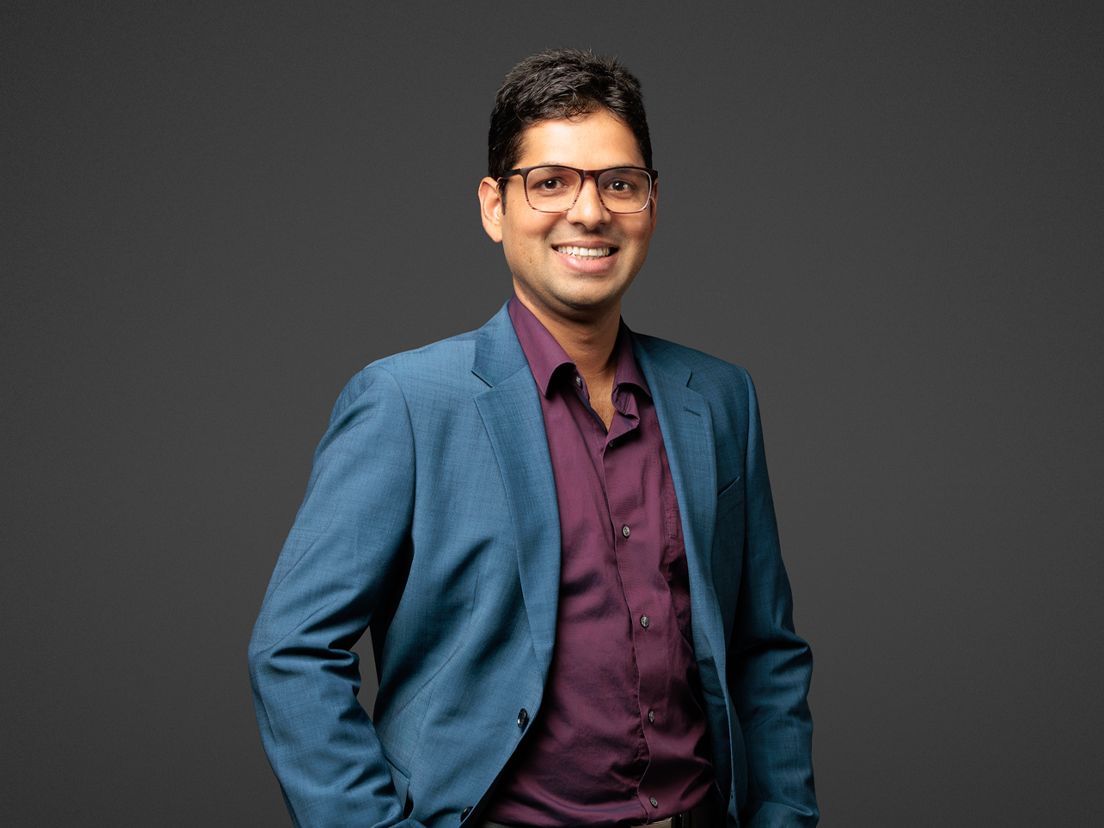
Biography
I was born in Uttarakhand, India. I completed my schooling and early college studies there, where I also met my beautiful wife. I then began working at BARC in Mumbai, during which time I decided to pursue higher studies outside India.
In 2014, I moved to London to pursue my PhD under the supervision of Professor Richard Thomson. In 2018, I moved to Innsbruck for my postdoctoral research. During my time there, I developed a strong interest in quantum simulation with trapped atomic ions, as well as a passion for skiing. I fell in love with the mountains, deepened my engagement with quantum technology, and cultivated a strong scientific curiosity under the guidance of Prof Rainer Blatt, Prof Christian Roos, and Prof Peter Zoller.
My time in Innsbruck was also personally transformative, as our family grew from two to four with the arrival of our daughter and son. After about eight wonderful years, I moved to Singapore to further develop my scientific interests from a new perspective, beyond what I had explored during my PhD and postdoctoral work. Over the years, I have had the privilege of meeting many wonderful people—from Mumbai to London to Innsbruck—and I truly hope to have the same enriching experience in Singapore.
Education
- PhD, Imperial College London, United Kingdom, 2018
- PG Diploma, HBNI, Mumbai, India, 2010 MSc Physics- GB Pant University of Agriculture and Technology, Pantnagar, India, 2009
Awards
- Marie Curie Early Stage Researcher 2014-2017
- CSIR NET JRF 2009
Research interest
I am an experimental physicist working with trapped atomic ions to develop quantum technologies for simulation and sensing. I also enjoy modelling and simulating systems on classical computers. My research focuses on atomic ions confined in a vacuum chamber using electric fields. These ions are laser-cooled to their motional ground state, and each ion is encoded as a qubit. The qubits are then manipulated using laser beams to perform quantum operations, including single- and two-qubit gates. Using this platform, I investigate quantum simulation of many-body physics, optimisation of classically hard problems, materials simulation, and quantum-enhanced sensing.
Selected publications
- T. Kraft, M. K. Joshi, W. Lam, T. Olsacher, F. Kranzl, J. Franke, L. K. Joshi, R. Blatt, A. Smerzi, D. S. França, B. Vermersch, B. Kraus, C. F. Roos, and P. Zoller, “Bounded-error quantum simulation via Hamiltonian and Lindbladian learning,” arXiv:2511.23392, 2025.
- L. K. Joshi, J. Franke, A. Rath, F. Ares, S. Murciano, F. Kranzl, R. Blatt, P. Zoller, B. Vermersch, P. Calabrese, C. F. Roos, and M. K. Joshi, “Observing the quantum Mpemba effect in quantum simulations,” Phys. Rev. Lett., vol. 133, p. 010402, 2024.
- J. Franke, S. R. Muleady, R. Kaubrügger, F. Kranzl, R. Blatt, A. M. Rey, M. K. Joshi, and C. F. Roos, “Quantum-enhanced sensing on optical transitions through finite-range interactions,” Nature, vol. 621, pp. 740–745, 2023.
- M. K. Joshi, C. Kokail, R. van Bijnen, F. Kranzl, T. V. Zache, R. Blatt, C. F. Roos, and P. Zoller, “Exploring large-scale entanglement in quantum simulation,” Nature, vol. 624, pp. 539–544, 2023.
- M. K. Joshi, F. Kranzl, A. Schuckert, I. Lovas, C. Maier, R. Blatt, M. Knap, and C. F. Roos, “Observing emergent hydrodynamics in a long-range quantum magnet,” Science, vol. 376, no. 6594, p. 720, 2022.
- F. Kranzl, M. K. Joshi, C. Maier, T. Brydges, J. Franke, R. Blatt, and C. F. Roos, “Controlling long ion strings for quantum simulation and precision measurements,” Phys. Rev. A, vol. 105, no. 5, p. 052426, 2022.
- M. K. Joshi, A. Elben, B. Vermersch, T. Brydges, C. Maier, P. Zoller, R. Blatt, and C. F. Roos, “Quantum information scrambling in a trapped-ion quantum simulator with tunable range interactions,” Phys. Rev. Lett., vol. 124, no. 24, p. 240505, 2020. [8] C. Kokail, C. Maier, R. van Bijnen, T. Brydges, M. K. Joshi, P. Jurcevic, C. A. Muschik, P. Silvi, R. Blatt, C. F. Roos, and P. Zoller, “Self-verifying variational quantum simulation of lattice models,” Nature, vol. 569, no. 7756, pp. 355–360, 2019.