

Biography
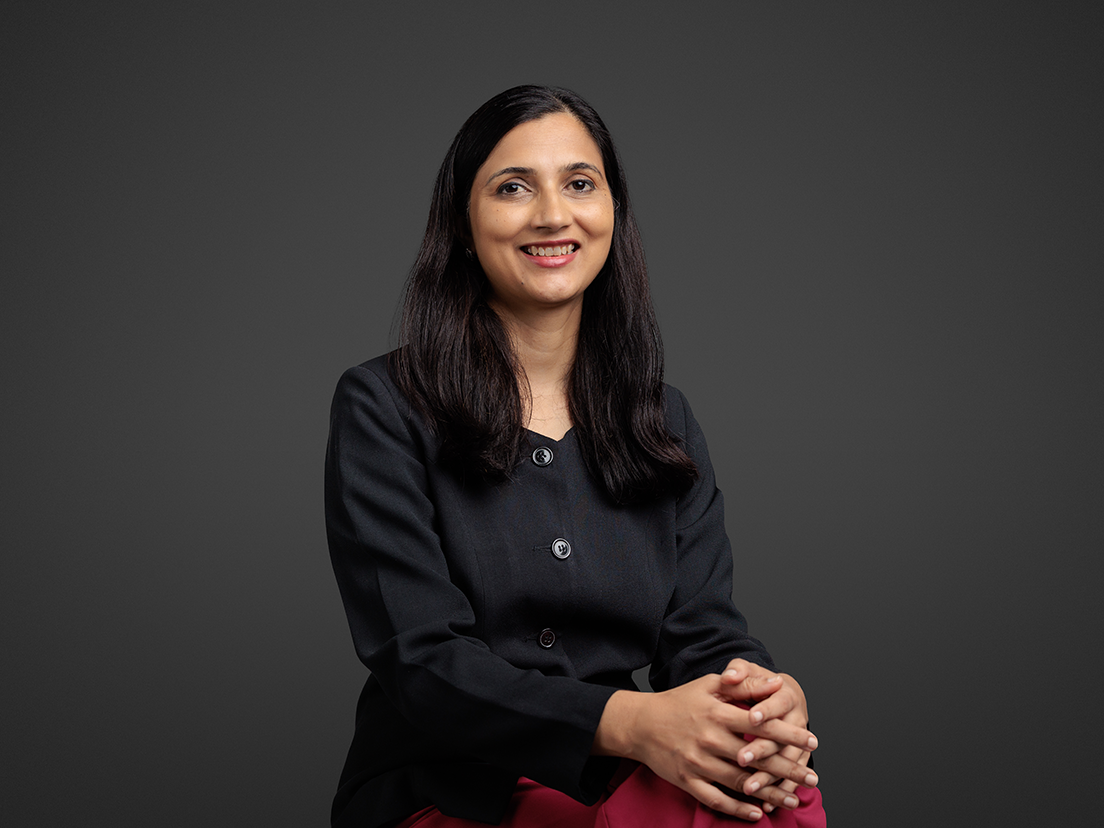
Dr Sumbul Khan holds a PhD in Computational Design (Architecture) from University of Strathclyde, United Kingdom. Dr Khan has considerable experience in research, teaching, mentoring and supervision. She is experienced in research grant writing involving inter-disciplinary research and is the primary author of two successful grant applications with a combined budget of over 1 million SGD. Dr Khan has led several research and design consultation projects at the former SUTD-MIT International Design Centre, and collaborated with stakeholders from diverse backgrounds. Her interests span design science, design and STEM education, architecture, generative design and human-computer interaction.
Education
- PhD in Computational Design, Dept of architecture, University of Strathclyde, United Kingdom
- Msc (Distinction) in Architecture Computing Studies, University of Strathclyde, United Kingdom
- Bachelor of Architecture, Indraprastha University, India
Research interests
Design Science and Design education, STEM Education, Computational Design, Human-Computer Interaction
Selected publications
- Khan, S., I. Hendra, S. T. Sudhindra, N. Muthalib and L. Blessing (2023), “Find the gap: An approach for visualizing and analysing design competencies in a university with interdisciplinary curriculum“, Proceedings of the 24th International Conference on Engineering Design, ICED23 Bordeaux, France 24-28 July 2023
- Khan, S., Blessing, L., Ndiaye, Y. (2023). “Artificial intelligence for competency assessment in Design education: a review of literature”. Proceedings of the 9th International Conference on Research into Design, ICoRD’23, Indian Institute of Science, Bangalore, India, 9-11 Jan 2023, Springer.
- S. Khan, M.Lee, L.Ong, S.Chua, L. Blessing (2021), Stories on the Transformation of Education by Design, Singapore University of Technology and Design. ISBN 978-981-18-2043-4.
- Khan, S., A. Achenbach, W. Q. Yow and L. Blessing (2021), “A case study on the design of touch-based user interfaces for multilingual older adults from southeast-asian backgrounds” Proceedings of the 5th Asian CHI Symposium, May 7th-8th, 2021.
- Khan, S., L. Blessing (2020), Assessment in Design Education: The potential of AI, Eduscapes 2020: An SUTD Pedagogy Newsletter, Edition 4
- P.Silva, Khan, S.& L. Blessing (2020), State of Design Education in Singapore: Insights from the Design Education Summit 2018, Proceedings of the Design Society: DESIGN Conference 1, 1805-1814.
- Khan, S., K. Maheshwary, R. Arlitt and L. Blessing (2020) “Assessment of conceptual design problems comprising design rationale and sketches” in International Design Engineering Technical Conferences and Computers and Information in Engineering Conference IDETC/CIE2020 August 16-19, 2020, St. Louis, MO, USA
- Arlitt R, Khan, S., Blessing L, (2019) “Feature Engineering for Design Thinking Assessment”, Proceedings of the 22nd International Conference on Engineering Design, 5 – 8 August 2019 Delft, The Netherlands.[Best Paper award]
- Khan, S and Tunçer, B. (2019) “Gesture and speech elicitation for 3D CAD modeling in conceptual design”, Automation in Construction, 106, p. 102847. doi: 10.1016/j.autcon.2019.102847.[Journal Impact Factor 4.3]
- Khan, S. and Tunçer, B. (2019) “Speech analysis for conceptual CAD modeling using multi-modal interfaces: An investigation into Architects’ and Engineers’ speech preferences”, Artificial Intelligence for Engineering Design, Analysis and Manufacturing. Cambridge University Press, pp. 1–14. doi: 10.1017/s0890060419000015.
- Khan, S., Tuncer B, Subramanian R, Blessing L. (2019) “3D CAD modeling using gestures and speech: Investigating CAD legacy and non-legacy procedures”, in Proceedings of CAAD futures 2019. Daejeon, South Korea.
- Tunçer, B. andKhan, S.(2018), “User Defined Conceptual Modeling Gestures”, in Ji Hyun-Lee (Ed.), Computational Studies on Cultural Variation and Heredity, Springer, Singapore, pp. 115–125.
- Khan, S., Tuncer B (2017) “Intuitive and effective manipulation gestures for 3D CAD modeling for conceptual architectural design”, ACADIA 2017-Association for Computer Aided Design in Architecture, MIT, USA.
- Khan, S., Rajapakse H, Zhang H, Tuncer B, Nanayakkara S, Blessing L (2017) “GesCAD: An Intuitive Interface for Conceptual Architectural Design, OzCHI 2017: Human-Nature—The 29th Australian conference on Human-Computer Interaction, Brisbane.
- Khan, S., Chase S C, 2016, “Strategic style change using grammar transformations”, Artificial Intelligence for Engineering Design, Analysis and Manufacturing, Cambridge University Press.
- Ahmad Khan S, Chase S C, 2012 “Style representation in design grammars”, Environment and Planning B: Planning and Design, 39(3) 486 – 500.
- Ahmad Khan S, 2012, “Representation of Type in grammatical design” in Proceedings of the 17th International conference of the Association for Computer Aided Architectural Design Research in Asia (CAADRIA), 25-28 April 2012 Chennai, India.
- Ahmad Khan S, Chase S, 2007, “Transforming grammars for goal driven style innovation: testing a methodology”, in Predicting the Future, Proceedings of the 25th Conference on Education in Computer Aided Architectural Design in Europe Ed J Kieferle, J Ehlers (eCAADe, Frankfurt) 879-88
- Ahmad Khan S, Chase S, 2006 “Grammar Representations to Facilitate Style Innovation: An Example From Mobile Phone Design”, in Communicating Spaces, Proceedings of the 24st Conference on Education in Computer Aided Architectural Design in Europe Ed V Bourdakis, D Charitos (eCAADe, Volos ) 320-324
- Chase, S.C. and Ahmad Khan, S; Martins, Bob and Brown, Andre, eds. (2005) Grammar transformations : using composite grammars to understand hybridity in design. In: CAAD futures 2005. CAADFutures . IRIS-ISIS Publications, GBR, pp. 89-98. ISBN 3854372760