
A method to achieve enhanced magnetic localisation with artificial neural network field models
A method to achieve enhanced magnetic localisation with artificial neural network field models
Technology title
A method to achieve enhanced magnetic localisation with artificial neural network field models
Technology overview
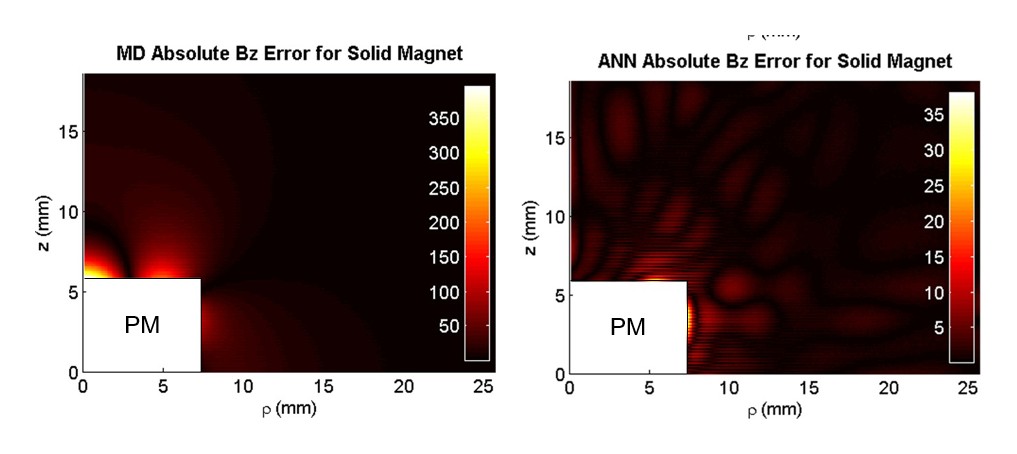
This invention relates to a method for improving the accuracy of magnetic localisation in medical and healthcare applications. The method models the magnetic field of axisymmetric permanent magnets with artificial neural networks, which permits accurate field modeling even at close proximity to the magnet. The model has low computational intensity and can easily be used in real-time and may be integrated into applicable electromagnetic tracking systems that require magnetic field modelling.
Technology specifications
This technology provides a framework to enhance existing electromagnetic tracking (EM) systems which are widely used in the medical domain for instrumentation tracking and coordination.
Sector
Personal and healthcare.
Market opportunity
Most of magnetic localisation and orientation systems use single dipole models to calculate magnetic field, which, due to the fundamental limitation of the dipole, become inaccurate as the sensors approach the surface of the magnet. Moreover, they are unable to account for geometry, magnetisation and any physical imperfections of the magnetic source. Currently the spatial volume directly around the field generator of most EM tracking systems is unusable because of the inadequacies of the magnetic dipole model.
This technique can be seamlessly integrated into existing EM tracking systems (heavily used in the medical community for tracking of surgical instruments) for improved tracking performance when the field generator and sensor are in close proximity. By harnessing this artificial neural network-based magnetic field model, these zones can now be utilised without any physical alteration to the systems. As these EM tracking systems are getting smaller and more compact, this increase in usable tracking volume can be crucial in the adoption in new medical applications.
Applications
This technology is applicable in the following industries:
- Real-time medical guidance, such as capsule endoscopy
- Minimally invasive surgery
- Biomechanical analysis and kinesiologic studies
- High precision electric motor/actuator control
Customer benefits
The technology offers enhanced position and orientation tracking accuracy and a wider spatial tracking space. Existing systems can be refitted with minimal changes.
Technology readiness level
TRL 6-7
Ideal collaboration partner
Open to all partnership opportunities.
Collaboration mode
Open to all collaboration types.