
A novel photoluminescence theory and design rule based on entropy of fusion for rare earth ion doped alkaline metal silicates
A novel photoluminescence theory and design rule based on entropy of fusion for rare earth ion doped alkaline metal silicates
Technology title
A novel photoluminescence theory and design rule based on entropy of fusion for rare earth ion doped alkaline metal silicates
Technology overview
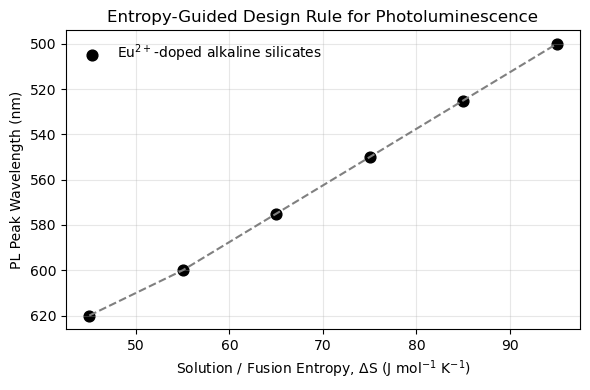
The technology invention presents a promising approach to determine the photoluminescence emission wavelength of rare earth ion doped alkaline earth silicates based on thermodynamics. Because no design principles for photoluminescent materials have been established. This will be helpful in predicting host chemical composition with tunable photoluminescence emission wavelengths particularly for developers of photoluminescence devices and for designing compositions of light emitting diodes
Technology specifications
In this technology invention, a generalised design rule was proposed for the estimation of host chemical composition. This design rule was sourced to explain the photoluminescence emission wavelengths of rare earth ion (Eu2+) doped alkaline earth metals (Ca, Mg) based silicates. FactSage was used to calculate the entropy of fusion of Eu2+ doped alkaline earth metal silicates. It is expected that the novel design rule mentioned in this research would pave a robust foundation in predicting host chemical composition with tunable photoluminescence emission wavelengths particularly for LEDs.
Sector
This invention is applicable to the LED lightings sector.
Market opportunity
In general, this technology can play an important role in photoluminescence-based applications, including light-emitting diodes and optical components used in medical devices.
Applications
Key applications include light emitting diodes.
Customer benefits
The technology opens an exciting frontier in entropy–lighting research, enabling the prediction of host chemical composition and tunable photoluminescence emission wavelengths, with specific relevance to light-emitting diodes. By replacing conventional trial-and-error material development with a thermodynamics-guided approach, the technology significantly accelerates development timelines while optimising candidate material selection.
Technology readiness level
TRL 1
Ideal collaboration partner
Ideal collaboration partners include photoluminescent device developer and manufactures.
Collaboration mode
This technology is open to discussion across various collaboration models.