
Conductive carbon coated polymer for high temperature lithium ion battery shutdown
Technology title
Conductive carbon coated polymer for high temperature lithium-ion battery shutdown
Technology overview
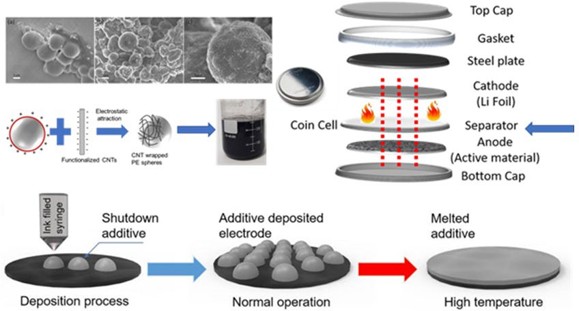
This technology relates to a lithium-ion battery with an improved electrode with automatic shutdown function. We have developed a method to generate a 3D printing ink to deposit a layer of thermal sensitive polymer, which can be implemented into the traditional battery production process to solve the thermal failure of the lithium-ion battery.
Technology specifications
The lithium-ion battery comprises a first electrode with a second electrode, and a shutdown polymer additive being provided on an outer surface of the first electrode. The shutdown polymer additive comprises at least two polyethylene (PE) layers, each PE layer comprising a plurality of PE microspheres. Each PE microsphere is wrapped with carbon nanotubes (CNT).
The PE microspheres interconnect with each other such that the carbon nanotubes form a conductive network. The PE layers are provided at predetermined areas of the outer surface of the first electrode. In the testing process, the battery can function as a normal battery. When the working temperature is above 90 degrees, the temperature-sensitive polymer will melt within 60 seconds. The polymer will block the pores of the electrode and the battery will stop charging and discharging.
Sector
This technology is applicable to the electronics sector, particularly in printed electronics.
Market opportunity
Global lithium-ion battery market is valued at about USD 43.4 billion in 2019 and is anticipated to grow steadily at more than 16% from 2020-2026. The lithium-ion battery is the leading choice of electrical energy storage for small portable devices and has great potential for large-scale implementation in electric vehicles. However, safety of the lithium-ion battery is a key concern.
The lithium-ion battery is susceptible to thermal failure, which can be triggered by overheating, overcharging, or short-circuiting of the battery. Though commercial lithium-ion batteries include several safety mechanisms, the internal shutdown separators are prone to shrinkage, resulting in short-circuiting of the electrodes, and the external safety devices may not be able to respond in time to thermal runaway events, which can occur as soon as a minute, after a short circuit of the battery
Applications
Key applications include portable electronics, electric vehicles, and military systems, as the automatic shutdown function can be implemented across various types of batteries.
Customer benefits
-
Shorter shutdown time when thermal runaway is about to occur, with minimal impact on battery performance.
-
Enables automatic shutdown of the coin cell within 60 seconds at temperatures above 90°C.
-
Maintains strong performance, with impact kept below 5%.
-
Shutdown layers can be deposited on the separator or electrode in 15 minutes, supporting efficient production processes.
Technology readiness level
TRL 3
Ideal collaboration partner
Ideal collaboration partners include battery manufacturing companies.
Collaboration mode
Licensing