
Defect rich carbon modified MgO nanoparticles for enhanced catalytic degradation of wastewater pollutants
Defect rich carbon modified MgO nanoparticles for enhanced catalytic degradation of wastewater pollutants
Technology title
Defect rich carbon modified MgO nanoparticles for enhanced catalytic degradation of wastewater pollutants 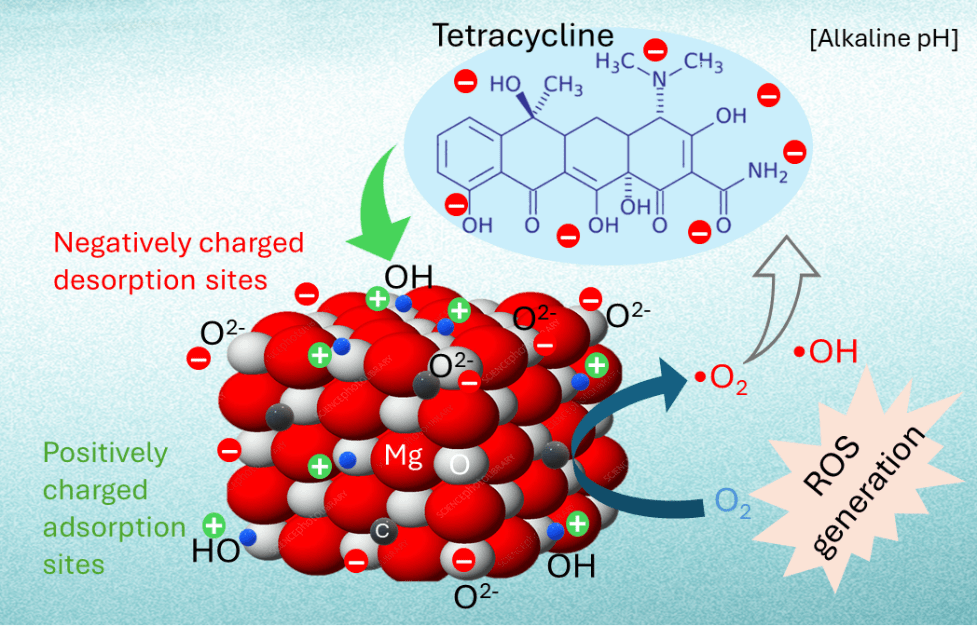
Technology overview
This technology presents a novel, cost-effective self-regenerating carbon modified magnesium oxide (C–MgO) nanoparticles for efficient catalytic degradation of tetracycline antibiotics.
The C-MgO nanoparticles are engineered via a novel synthesis route combining non-equilibrium kinetically driven spray drying and steam-assisted densification of Mg(OH)₂, strategically designed to enhance catalyst active site density and stability. This dual-step approach promotes the formation of abundant surface basic sites (low-coordinated O²⁻ and hydroxyl groups) and oxygen vacancies, markedly improves reactive oxygen species (ROS) generation and pollutant–catalyst interactions through pH-driven dynamic active site regeneration during catalytic operation.
The catalyst achieved 97% tetracycline removal within 60 minutes using only 1 g/L representing the highest reported efficiency for an MgO-based catalyst at a low dosage. ROS scavenger experiments identified superoxide and hydroxyl radicals as key species in the degradation process.
The catalyst demonstrated excellent reusability and stability in the presence of coexisting anions, underscoring its promise as a scalable solution for antibiotic removal in wastewater treatment. These results highlight the potential of C-MgO nanocomposites as a cost-effective, environmentally friendly material for efficient antibiotic removal from wastewater.
Technology specifications
Our carbon-doped MgO/C nanocomposites are designed as a highly efficient, cost-effective, and environmentally friendly solution for antibiotic degradation in wastewater and aquaculture effluents. The material features an enhanced density of active defect sites, including oxygen vacancies and surface basic sites such as low-coordinated O²⁻ species and hydroxyl groups, which collectively improve adsorption and catalytic interactions with contaminants like tetracycline.
The nanocomposites are synthesised via a scalable process combining steam-assisted densification of Mg(OH)₂ with controlled thermal dehydroxylation, followed by rapid carbon incorporation through spray-drying. This approach maximises the formation of reactive sites while maintaining structural stability and promotes continuous interaction between the material and target molecules, mitigating active site fouling.
Performance tests indicate that these MgO/C nanocomposites achieve high catalytic efficiency at lower dosages, with sustained activity over repeated use. The technology is suitable for treating pharmaceutical contaminants in wastewater, as well as organic dye-containing industrial effluents, offering customers an effective solution for cleaner water with lower operational costs.
Sector
This technology targets efficient wastewater treatment across municipal, industrial, aquaculture, and pharmaceutical sectors, as well as environmental technology and research applications.
Market opportunity
Rising global concern over antibiotic contamination and antimicrobial resistance (AMR) is driving demand for more effective and affordable wastewater treatment materials. Current technologies (advanced oxidation, activated carbon, membranes, biological treatment) often suffer from fouling, high operating costs, or incomplete removal of pharmaceutical pollutants.
The self-regenerating C–MgO nanocatalyst offers a low-cost, high-efficiency alternative, capable of rapid tetracycline degradation with minimal catalyst loading. Particularly strong market needs exist in aquaculture-intensive regions (China, Vietnam, India, Indonesia, Norway, Chile), pharmaceutical manufacturing, municipal wastewater treatment, and industrial dye effluent treatment.
Applications
Applications include removing pharmaceuticals like tetracycline from wastewater and aquaculture and treating organic dye-containing effluents.
Customer benefits
MgO/C nanocomposites provide an efficient, eco-friendly, and cost-effective way for customers to remove antibiotics and other organic pollutants from wastewater, supporting cleaner water and lower treatment costs.
Technology readiness level
TRL 3
Ideal collaboration partner
We are open to all collaboration partners.
Collaboration mode
We are open to R&D collaboration, licensing, IP acquisition.