
Foldable Single Actuator Monocopter (F-SAM)
Technology title
Foldable Single Actuator Monocopter (F-SAM)
Technology overview
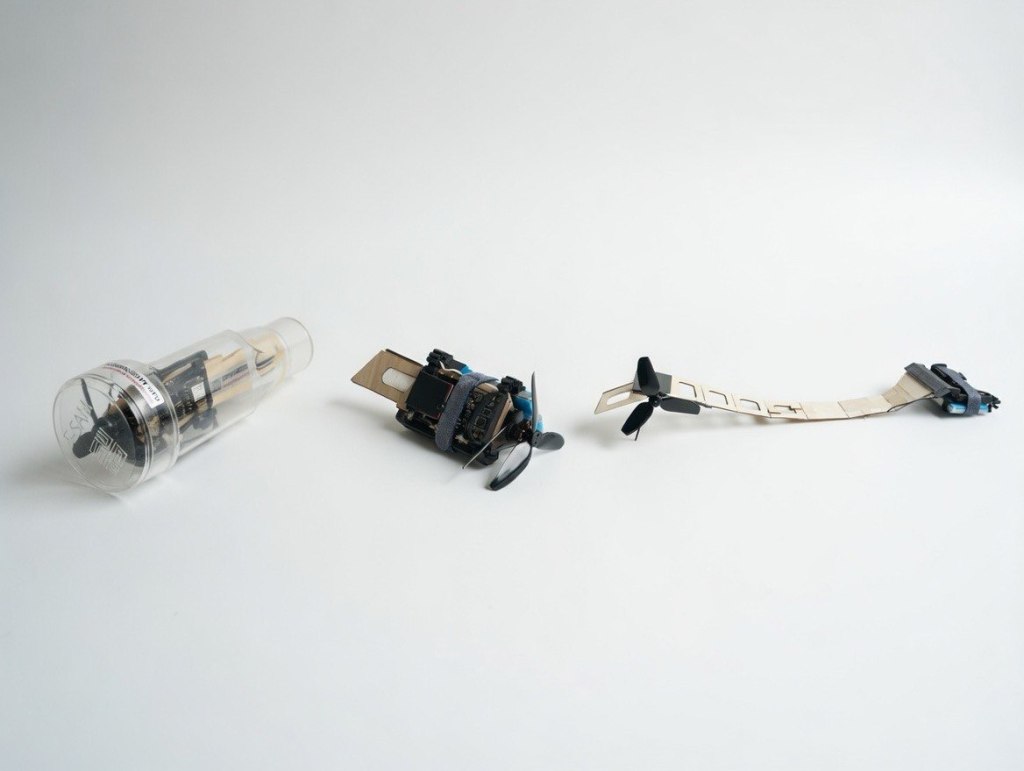
The F-SAM (Foldable Single-Actuator Monocopter) is a bio-inspired micro aerial vehicle that achieves fully controllable 5-DOF flight using only a single motor, solving the traditional trade-off between mechanical complexity and portability 69% reduction in size when folded. By utilising a semi-rigid wing that uses centrifugal force to stiffen during flight and a “pulsed control” logic for navigation, it addresses the market’s need for a highly energy-efficient (16-minute endurance with 8.4V 500mAH) and “pocketable” drone that reduces points of failure compared to multi-rotors. This IP is primarily targeted at military reconnaissance and environmental research, where it serves as a low-cost, disposable drone or a specialised payload delivery system for “seeding” remote sensors. Its natural spinning motion provides a built-in rotating platform for LiDAR sensors, while its inherent ability to autorotate ensures it can deliver payloads or land safely like a maple seed in the event of a power failure, making it ideal for single-use, GPS-guided missions in challenging environments.
Technology specifications
The monocopter weighs 69 grams and operates with a single electric motor that provides both propulsion and control. It achieves altitude regulation through thrust modulation across rotational cycles, while lateral motion is controlled via precisely timed thrust pulsing within each rotation. A hybrid Proportional Stabiliser Controller combined with a Proportional-Integral Position Controller enables closed-loop autonomous flight using motion-capture feedback. The system supports waypoint tracking and trajectory tracking, reaches a maximum lateral speed of approximately 2.6 m/s, draws an average power of 9.78 W, and achieves up to 16 minutes of flight time in hover. Its inherent autorotation capability provides a passive fail-safe descent mode in the event of power loss, further enhancing operational safety.
Sector
The F-SAM fills a unique gap in the “Low-Cost, High-Portability, Disposable” aerospace market. It specifically targets sectors where traditional drones are too expensive or bulky to lose:
- Defence & ISR: A “pocketable,” disposable scout for squad-level reconnaissance in high-risk zones.
- Environmental research: A “smart” alternative to weather balloons; it can steer sensors to precise GPS coordinates during descent.
- Industrial inspection: A natural platform for LiDAR mapping, as the drone’s inherent spinning motion removes the need for a separate, heavy sensor motor.
- Precision agriculture: Ideal for “swarm seeding” or targeted delivery of fertilisers in remote reforestation projects.
- Emergency response: A safe, ultra-lightweight “first eye” that can be tossed into collapsed buildings or hazardous areas to locate survivors.
Essentially, the F-SAM occupies the space between unguided sensors and expensive multi-rotors, offering a specialised solution for single-use or high-risk payload missions.
Market opportunity
The market opportunity for the F-SAM lies at the intersection of the Small Drone Market (projected at $28.3 billion by 2030) and the rapidly growing Disposable Recon Drone sector, which is expanding at an 18.2% CAGR. As defence and commercial industries shift toward “attritable” (low-cost, replaceable) technology, the F-SAM’s single-actuator design offers a significant price advantage over complex quadcopters. It is uniquely positioned to capture the “pocket-sized ISR” and “automated sensor deployment” niches, where its 69% footprint reduction and inherent compatibility with spinning sensors like LiDAR provide a specialised, high-efficiency solution that traditional multi-rotors cannot match.
Applications
The technology supports the rapid and portable deployment of lightweight payloads and sensor platforms, addressing operational needs in military and civilian sectors. Key applications include surveillance, reconnaissance, environmental and field research, and search-and-rescue missions, particularly in scenarios requiring compact systems, rapid mobilisation, and operation within confined or remote environments.
Customer benefits
The F-SAM offers three distinct benefits that set it apart from traditional multi-rotors and other micro-drones:
- 69% Footprint Reduction (Ultra-Portability)
The F-SAM is the first of its kind to feature a foldable, semi-rigid wing. While traditional monocopters are awkward to transport due to their long, rigid wings, the F-SAM can be rolled up like a “Swiss Roll” to fit inside a pocket or a small tube. During flight, centrifugal force automatically stiffens the wing, allowing it to transition from a compact storage state to a high-performance aerial vehicle in seconds.
- Inherent “Fail-Safe” via Autorotation
Unlike quadcopters that fall uncontrollably if a motor fails or the battery dies, the F-SAM is aerodynamically stable by design. Inspired by the maple seed, it will naturally enter a state of autorotation, spinning gracefully to the ground. This makes it an ideal platform for delivering sensitive payloads or sensors, as the vehicle protects its cargo even during a total power loss.
- Optimised for spinning sensors (Future LiDAR potential)
While the current F-SAM is a streamlined flight prototype, its architecture is uniquely “LiDAR-ready” by design. Most high-end mapping sensors require a dedicated internal motor to spin a laser and create a 360-degree scan; adding significant weight and battery drain. Because the F-SAM’s entire body naturally rotates at high speeds to maintain flight, a static, lightweight LiDAR or Time-of-Flight (ToF) sensor could be mounted directly to the frame without an additional motor.
By leveraging the drone’s inherent physics, a future integrated version could eliminate the mechanical complexity, weight, and power consumption of a traditional spinning sensor mount. This makes the F-SAM a highly feasible candidate for the world’s smallest flying LiDAR platform, capable of performing high-precision 3D mapping in a package that remains “disposable” and ultra-portable.
Technology readiness level
TRL 6-7
Ideal collaboration partner
The ideal collaboration partners include:
- Defence & aerospace (e.g., ST Engineering, Thales Singapore): Leverages the established SUTD-Thales MOU and Temasek Labs funding to transition the F-SAM from a TRL 7 prototype into a militarised ISR asset. Its 69% foldable footprint and single-actuator reliability make it a prime candidate for “swarm” deployments and “launch-and-forget” tactical scouting within the Singapore defence ecosystem.
- Environmental & industrial sensing (e.g., Dyson, NEA, or local Surveying firms): Capitalises on the F-SAM’s James Dyson Award-winning “airXeed” radiosonde application. Collaborating with agencies like the National Environment Agency (NEA) or industrial firms would scale the platform as a sustainable, steerable alternative to traditional weather balloons or as the world’s smallest flying LiDAR platform for GPS-denied mapping.
- Commercial robotics integrators (e.g., DJI, AeroLion Technologies): Focuses on “Design AI” and autonomous systems to refine the F-SAM’s unique 5-DOF control for urban logistics and infrastructure inspection. These partners can integrate the F-SAM’s endurance-to-weight advantage into existing UAV fleets for specialised “last-centimeter” data collection in obstacle-rich environments.
Core fit: Singapore-based defence/tech firms (ST Engineering/HopeTech/Thales) for fastest path to operational testing/commercialisation, given SUTD location, funding history, and regional UAV focus.
Collaboration mode
This technology is suitable for all collaboration modes including: R&D collaboration, licensing, IP acquisition and test-bedding.