
Microfluidic biophysical phenotyping for single cell analysis
Technology title
Microfluidic biophysical phenotyping for single cell analysis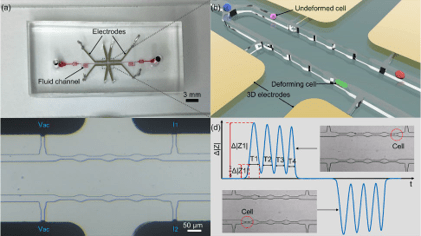
Technology overview
This invention is a microfluidic device using multiple microscale constrictions to squeeze and release cells and then evaluate cell deformability, cell electrical impedance and cell shape recovery capacity using electrical impedance measurements. The transit time required for the cell to pass through the constriction can be quantified as the indicator for cell deformability and the measured impedance reflects the cell electrical properties. The time ratio of cell through different constriction channels will reflect the cell shape recovery capacity.
Technology specifications
Biophysical properties of cells (e.g. size, morphology, deformability and electrical impedance), reflective of the cell’s biochemical and physiological characteristics such as gene expression, cellular content and cytoskeleton, have been proven as promising label-free biomarkers for studying, characterising and discriminating different cell populations in complex biological samples.
For example, cell deformability (i.e. the ability to deform under mechanical forces), associated with cytoskeletal or nuclear properties, has also been identified as a label-free biomarker to determine cell type and state. For example, changes in the deformability of red blood cells (RBCs) are associated with several highly prevalent diseases, for example malaria, diabetes mellitus, sickle cell anemia, and spherocytosis.
Atomic force microscopy, micropipette, and optical tweezers are standard tools for cell mechanical properties study. However, these techniques have a very low throughput (<1 cell/min) and the operation is labour-intensive and time-consuming. Electrical properties of cells are also label-free indicators of cell states, which can be measured by flowing single cells through microscale electrodes. Here, we present a new microfluidics technology that can measure multiple biophysical properties (i.e. size, morphology, deformability and electrical impedance) of a large population of individual cells at a very high-throughput (~10,000 cells per min).
Sector
This technology is applicable to the medical technology sector.
Market opportunity
This technology can address the market need in high-throughput single cell analysis without labelling. The market size is expected to be more than USD 1 billion in the field of clinical diagnosis and drug screening.
Applications
Some applications include single cell analysis, clinical diagnosis and drug screening.
Customer benefits
Easy to use, provides real-time measurements, enables multi-parameter phenotyping, is label-free, and supports high-throughput analysis.
Technology readiness level
TRL 4
Ideal collaboration partner
We are looking for potential licensees to commercialise this technology.
Collaboration mode
Commercialisation