
Transformable Hovering Rotorcraft
Technology title
Transformable Hovering Rotorcraft (THOR)
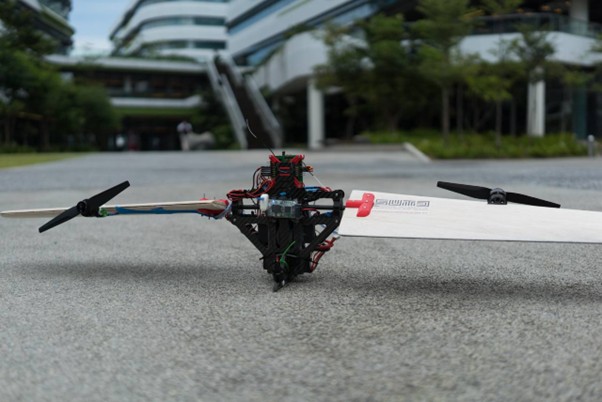
Technology overview
The technology is developed to create a hybrid UAV that is efficient in both long-range, high-speed flight (cruising mode) and agile stationary flight (hover mode). The THOR is an under-actuated system that can operate as either a long-range cruising fixed wing or an agile hovering rotorcraft. This is achieved via a specific combination of two wings, two servos and two motors that are fully utilised in both modes. This results in a true hybrid UAV that is capable of both endurance and agility. Each wing has a motor mounted in its forward direction and a servo mounted near its root chord to control the direction of both the motor’s thrust force and the wing’s lift force, respectively. In its cruising mode, the craft operates akin to a flying wing while in its hovering mode, the craft operates akin to a monocopter.
Technology specifications
The innovation takes advantage of and accommodates for two phenomena unique to this form of hybrid, gyroscopic precession and asymmetrical blade loading. The former produces a torque along each wing while in hovering mode due to the simultaneous rotation of the craft and each individual motor. The effect is used to increase and/or each wing’s angle of attack, thereby controlling the hovering mode’s altitude and attitude. The latter can either improve or impair the torque effects while in hovering mode as rotation of the craft produces a non-uniform inflow at each motor. By arranging the craft and motor rotation in the same direction, the torque is increased thereby improving the power efficiency of the hovering mode.
The transition mechanism is unique to this hybrid in that it uses only the aerodynamic surfaces, motors and servos already implemented for the two flight modes to execute a transition. The mechanism executes a transition by rotating the wings into the direction of the flight mode of choice. Motor thrust is controlled during these stages to ensure that the craft is oriented properly. When transitioning from hovering mode to cruising mode, the THOR takes advantage of the positive angle of attack necessary in either mode to execute a clean transition that consistently leaves the craft the right side up during cruising mode.
Sector
This invention is primarily applicable to the Unmanned Aerial Systems (UAS) and Aerospace sectors. Because it bridges the gap between high-speed fixed-wing aircraft and agile hovering rotorcraft, it is particularly valuable for industries requiring both long-range endurance and precision manoeuvrability.
- Defence and security: Used for tactical reconnaissance and surveillance (ISR) in diverse environments (urban, maritime, and open terrain). Its quiet hover and small profile make it ideal for covert operations.
- Disaster relief and search & rescue: Rapidly reaching disaster zones at high speed and then hovering to perform close-up inspections or deliver critical medical supplies (e.g., first aid kits, medicine).
Market opportunity
Current market data (as of early 2026) shows the global fixed-wing VTOL UAV segment valued at approximately USD 0.7–1.3 billion in 2025, with projections reaching USD 1.2–3.8 billion by 2030 at CAGRs of 11.7–23.5% across reports from MarketsandMarkets, Mordor Intelligence, and others; broader VTOL/hybrid drone markets grow even faster, some exceeding 20% CAGR toward USD 7–11 billion by 2030–2031, fueled by defence ISR, commercial logistics, agriculture monitoring, infrastructure inspection, disaster response, and environmental surveying.
Applications
Key applications include but are not limited to aerial surveillance/reconnaissance, long-range payload delivery and visual display entertainment.
Customer benefits
The technology enhances structural efficiency in hybrid UAVs by eliminating aerodynamic and propulsion redundancies found in current-generation designs. Unlike existing prototypes that are inefficient in one of the flight modes, THOR enables full utilisation of the craft for lift generation in both modes, resulting in a true hybrid UAV with improved performance and efficiency.
Technology readiness level
TRL 6–7
Ideal collaboration partner
Ideal collaboration partners include:
- Defence/aerospace (e.g., ST Engineering, Thales Singapore, or Elbit Systems affiliates) – leverages SUTD’s prior Thales MOU on drones/UAM, Temasek Labs funding, and Singapore defence ecosystem for militarised ISR/VTOL applications.
- Commercial UAV/logistics firm (e.g., DJI enterprise arm, Zipline, or local drone delivery players) – scales efficiency for urban/remote delivery, agriculture mapping, infrastructure inspection in obstacle-rich environments.
- Autonomous systems integrator (e.g., Quantum-Systems or Wingtra partners) – combines THOR’s compact hybrid monocopter edge with established fixed-wing VTOL platforms for enhanced endurance + manoeuvrability.
Collaboration mode
This technology is open to discussion across various collaboration models.