
SUTD and RSAF Launch Singapore’s First On-Site Fast Prototyping Design·AI Fab Lab
- Located at Sembawang Airbase, Singapore’s first on-site Design·AI Fab Lab @ RSAF embeds AI-driven experimentation and rapid prototyping within an operational airbase, delivering deployable solutions in hours and days instead of months and years.
- It is the first of several such labs that will be launched by SUTD, in partnership with organisations in a broad spectrum of industries, including urban planning and construction.
The concept of research labs has gone through a radical change with the Singapore University of Technology and Design’s (SUTD’s) latest initiative with the Republic of Singapore Air Force (RSAF).
Focussed on AI-driven experimentation and rapid prototyping, the SUTD Design·AI (D·AI) Fab Lab @ RSAF is the first in a series of on-site new age research labs which aim to deliver real-world results in previously unheard of timelines – hours and days, instead of months and years.
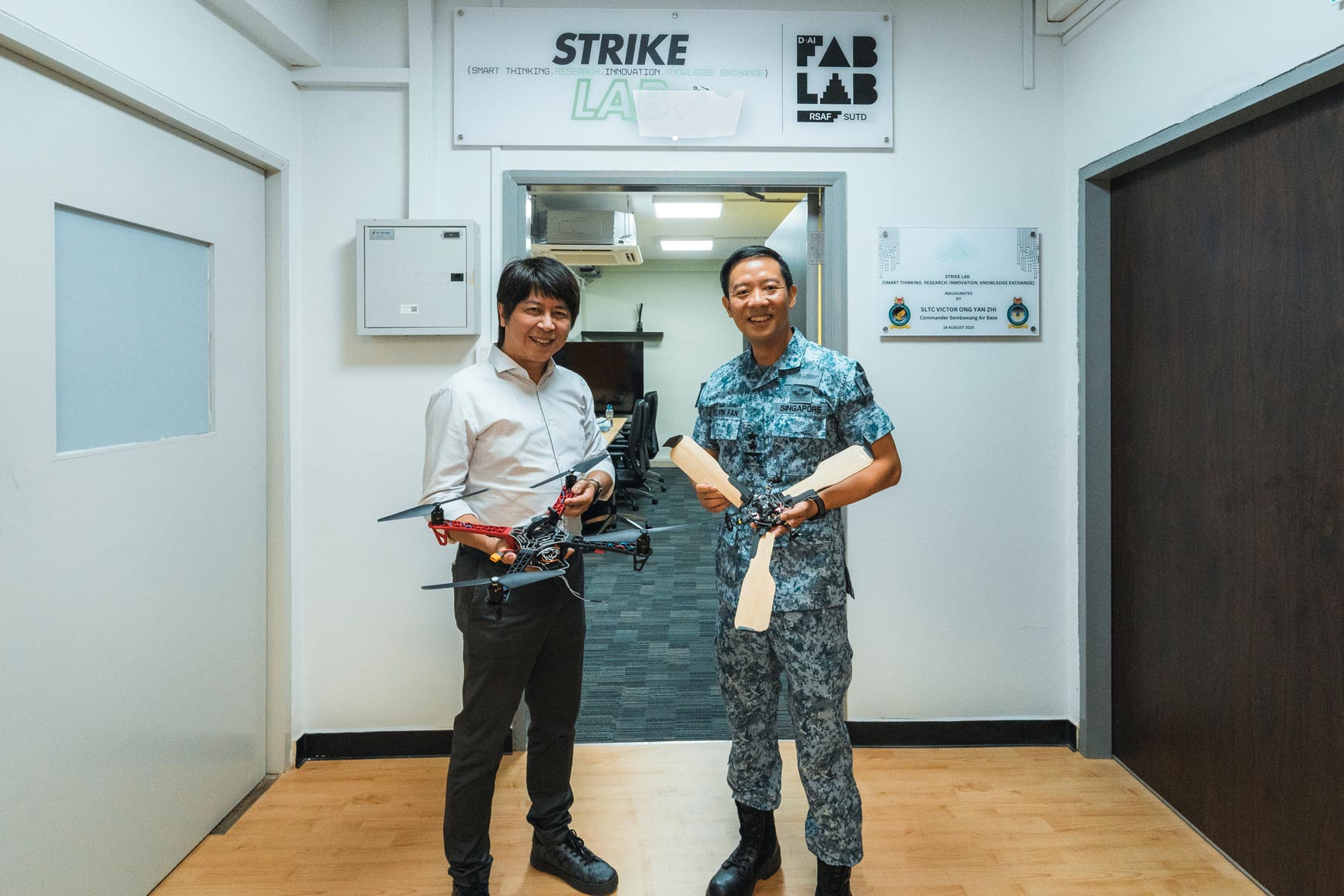
Professor Tai Lee Siang (left), Deputy President, SUTD, and Major General Kelvin Fan (right), Chief of Air Force at the Design·AI Fab Lab @Sembawang Airbase, which is a nexus for Institutes of Higher Learning and end-users to ideate and experiment together. (Image credit: MINDEF)
Located at Sembawang Airbase, the D·AI Fab Lab @ RSAF brings research, capability development and operational application into a single platform, accelerating the translation of ideas into deployable solutions that address defence and industry needs. It will enable RSAF personnel to acquire Design AI skills through hands-on experimentation, continuous prototyping and real-world problem-solving, delivering practical outcomes while building longer-term workforce capabilities.
Senior Minister of State for Defence Mr Zaqy Mohamad highlighted the importance of accelerating the trials and operationalisation of AI, advancing AI-enabled software, and deepening strategic partnerships with industry and academia. He said: “Recently, the RSAF partnered SUTD to open a Design·AI Fab Lab in Sembawang Airbase. This gives our airmen and engineers convenient, frequent access to AI, design and fabrication tools within their operational rhythm, encouraging rapid prototyping and fielding of inventive solutions to operational problems. These partnerships allow us to do things both better and new, by tapping industry expertise and harnessing AI to complement conventional systems and foster innovation.”
Presently, discussions around the D·AI Fab Lab @ RSAF are centred on how these capabilities could be applied to practical, real-world challenges. Many of these challenges are complex and multifaceted, cutting across operational workflows, safety considerations, the built environment and human factors, and are not easily addressed through traditional, linear approaches.
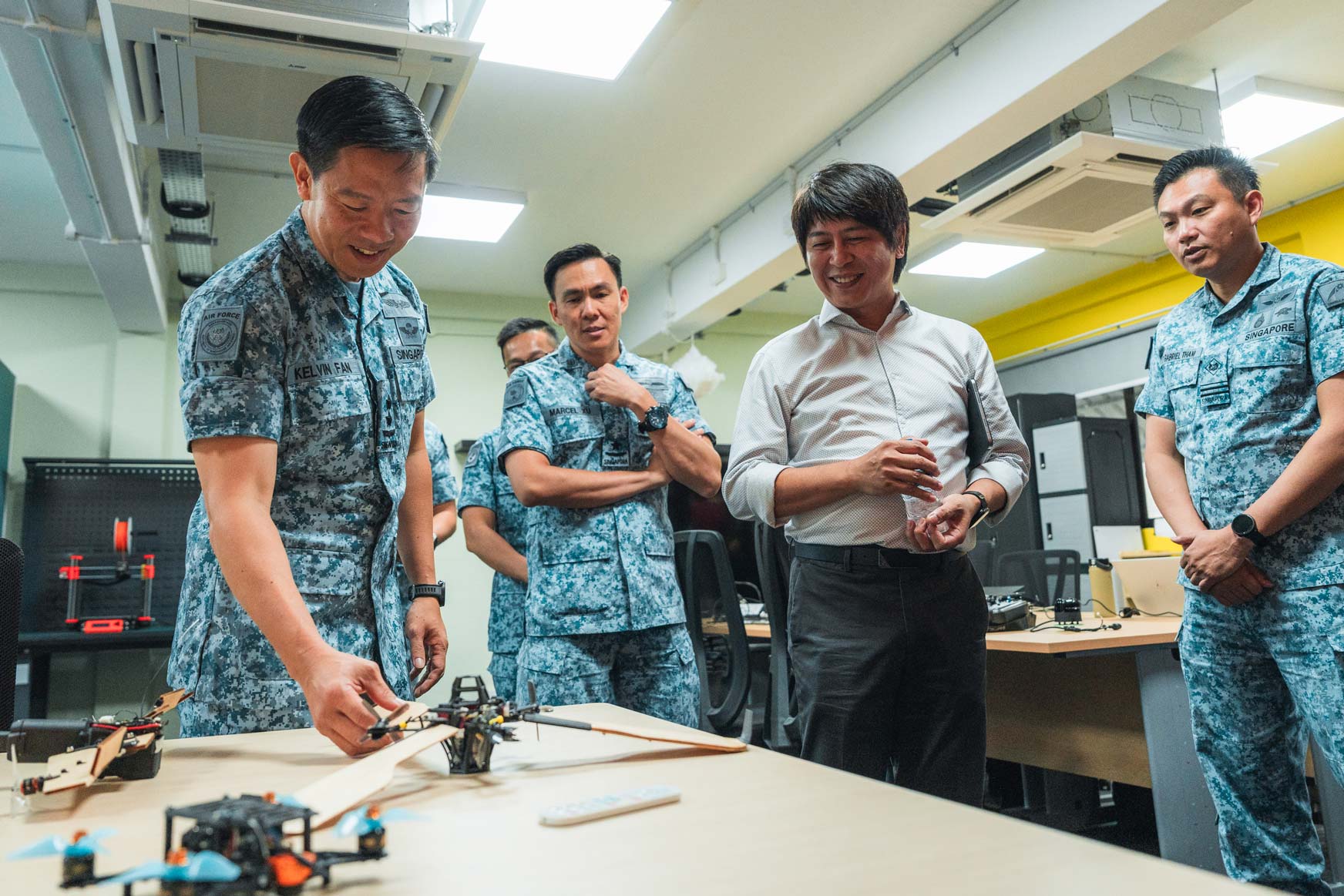
Major General Kelvin Fan (extreme left), Chief of Air Force and Professor Tai Lee Siang (not in uniform), Deputy President, SUTD, at the Design·AI Fab Lab @Sembawang Airbase discussing how the Fab Lab can accelerate ideas through rapid prototyping. (Image credit: MINDEF)
One example is the safe end-to-end transportation of large and heavy helicopter blades, which weigh over 160kg each, within congested areas that can lead to challenges on the ground and operational delays. Through simulation, rapid prototyping and user-centred design, teams can explore adjustments to the built environment, alternative routing strategies, traffic management approaches and assistive technologies to reduce bottlenecks and reliance on manual intervention. The Lab can also provide a platform to examine how the physical demands on technicians handling heavy components can be reduced, while improving overall workflow coordination.
SUTD Deputy President and Chief Innovation & Enterprise Officer, Professor Tai Lee Siang, said: “We are very excited to be partnering RSAF in this landmark initiative. As a university, we are keen to export our D·AI Fab Lab blueprint to industry partners because we strongly believe that all organisations, big or small, will have to embrace AI to be able to remain relevant in this new age.
“The D·AI Fab Lab @ RSAF reflects a shared belief that tackling complex, real-world challenges require workforce acculturation ahead of large-scale technological transformation. Embedded within an operational environment, the Lab will serve as a staging ground for testing and refining capabilities that enhance safety, efficiency and operational effectiveness, ensuring innovation is practised where it is needed most and feedback can be rapidly incorporated,” he said.
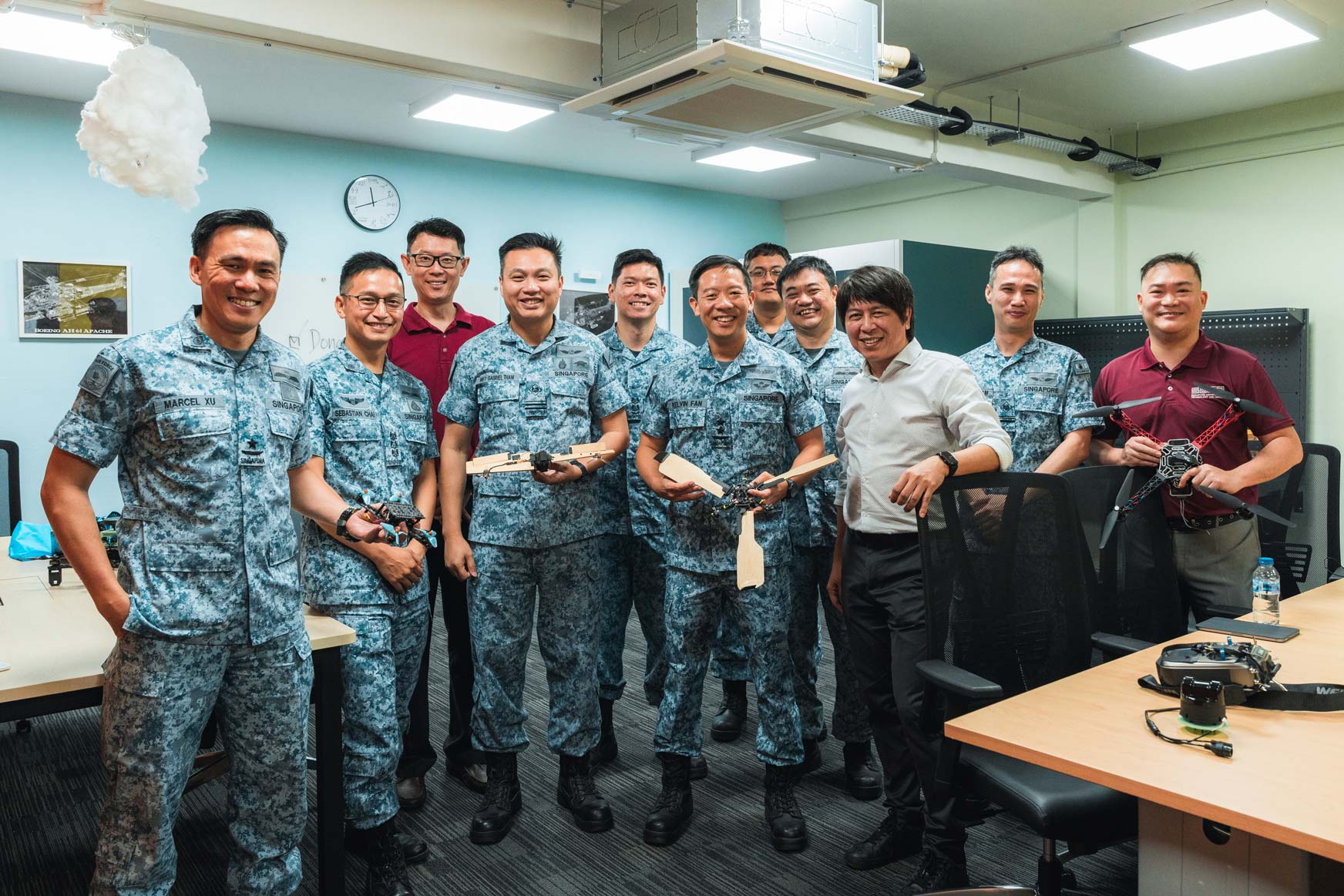
RSAF and SUTD staff in the newly opened Design·AI Fab Lab @Sembawang Airbase. The Design·AI Fab Lab represents a physical space for ideation and rapid prototyping. (Image credit: MINDEF)
Certainly, AI is already being used by militaries around the world, for example, to support command and control operations, enabling rapid data processing and informed decision making by developing algorithms that can assist commanders in navigating complex battlefield scenarios, ultimately allowing for human decisions at machine speed.
The D·AI Fab Lab concept was first piloted at SUTD in January 2025. It started out with a group of SUTD students who leveraged AI tools and rapid prototyping to constantly upskill themselves. Through iterative experimentation, they developed a whole range of user-centric solutions. One example is TextForm, a programme which enables anyone to design and 3D-print objects just by typing a description—no coding or computer-aided design expertise required. Another is the SUTDWiki, a Wikipedia of sorts on all student-related SUTD administrative matters. These early successes demonstrated the practical value of Design AI and positioned SUTD as a living laboratory for innovation and translation of ideas into real impact.
Beyond the RSAF, SUTD is also in discussions with several organisations in a broad spectrum of industries to roll out similar off-campus D·AI Fab Labs, including those in urban planning and construction.