

Singapore University of Technology and Design (SUTD)
Master of Science in Technology and Design (Urban Innovation and Design)
Programme schedule
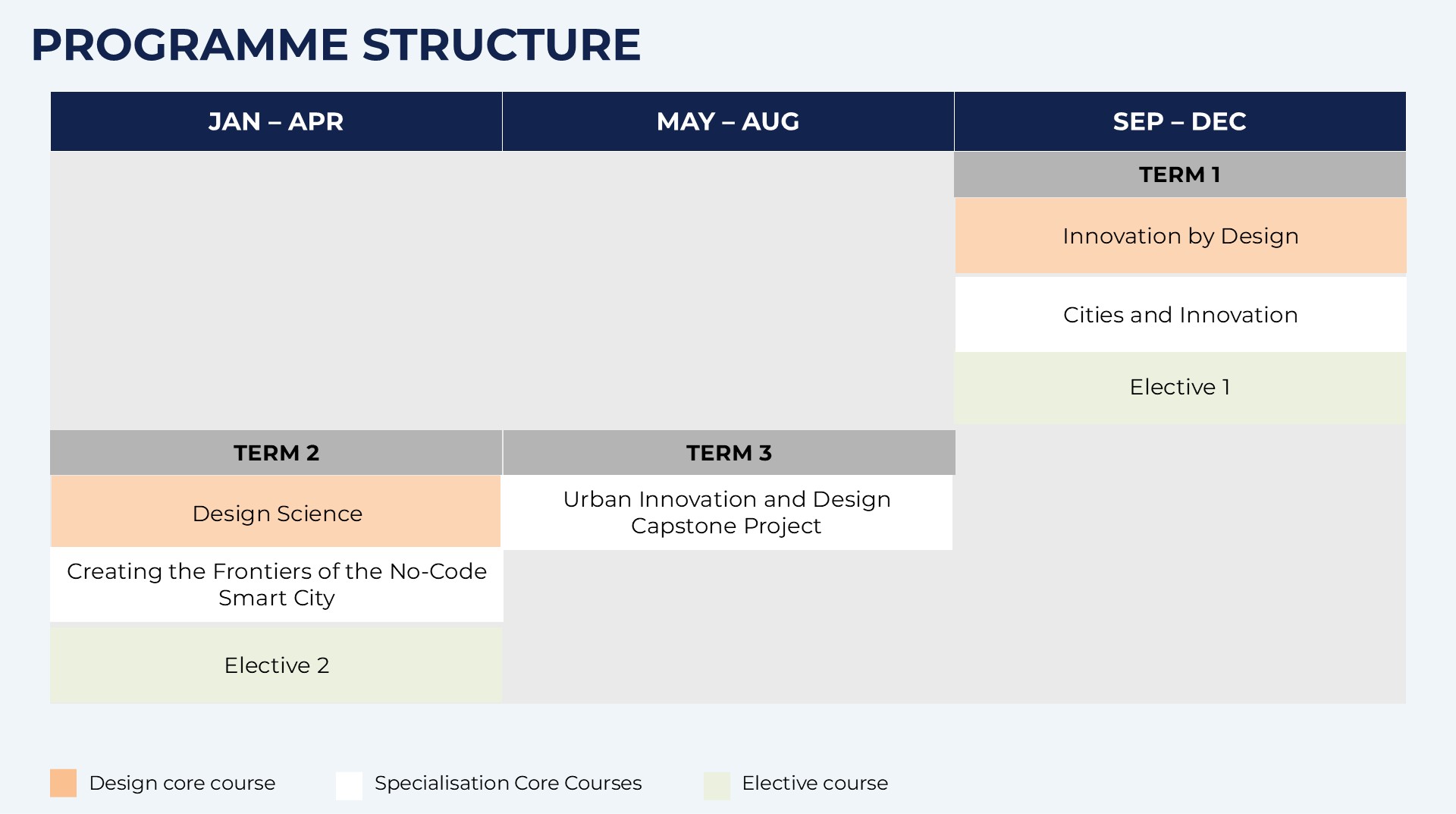
The MTD (Urban Innovation and Design) programme is a one-year full-time coursework-based Master programme. This programme comprises 96 credits delivered over three terms, with four core courses, two electives and an Urban Innovation and Design Capstone, organised as follows:
Course descriptions
Innovation by Design (12 credit points)
This course introduces students to the fundamentals of design thinking and its integration with technology to address complex, real-world challenges. Emphasising creativity, empathy, and iterative problem-solving, students will learn to apply design methodologies such as ideation, prototyping, and testing to develop innovative solutions. Case studies from the urban, public-sector industry will highlight the transformative impact of design-driven innovation. Through hands-on projects and user-centred tools, students will cultivate the skills and mindset necessary to drive meaningful innovation in technology-focused contexts. This course is designed to give an introduction to the four Ds of the four-phase Design Innovation Cycle of Discover-Define-Develop-Deliver.
Cities and Innovation (12 credit points)
This course explores how cities respond to change and how new ideas can improve urban life. Students will examine the relationships between people, technology, institutions and urban systems, considering what enables innovation and what stands in its way. Drawing on diverse urban challenges and examples, the module introduces ways to connect evidence and insights with opportunities for action, while considering how solutions can respond to community needs and work within different urban contexts.
Design Science (12 credit points)
This course will introduce students to design science where many design principles and methods will be reviewed, applied and analysed. Students will learn to make connections between design science and other fields in, for example, engineering and how principles in design science can be used to advance these fields. The class will cover a broad set of design methods such as customer needs analysis, methods in creativity, functional modelling, design for X, design for testing & verification.
Creating the Frontiers of the No-Code Smart City (12 credit points)
This course explores how people can use AI and no-code tools to shape better cities. Through readings, discussions and hands-on design activities, students examine urban strategy, emerging technologies, human-centred design, how change happens and who can innovate. Students learn to apply and critically assess AI throughout the design process, from understanding problems and generating possibilities to testing ideas and developing solutions that respond to real human needs. The course builds practical experience alongside an understanding of AI’s opportunities and risks, with opportunities, where available, to test solutions with partners and stakeholders.
Urban Innovation and Design Capstone (24 credit points)
The Capstone allows students to put their learning into practice by tackling a real-world urban challenge. Working primarily in multidisciplinary teams, students will frame the problem, design and test an intervention, and develop a credible pathway towards implementation and evaluation. The Capstone culminates in a professional project package demonstrating not only a strong idea, but how it could work in practice.
Electives
Students may choose two electives (12 credit points each) that align with their interests from the courses offered across the other MTD programmes in the respective terms.